
Travel plugs, form factor & materials: buyer questions
Travel adapters, foldable plugs, compact designs, finishes and materials: how form factor affects what a charger range can do.
-
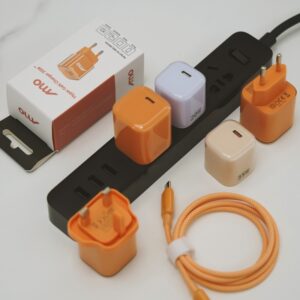
 Does a matte or glossy finish matter for charger returns and reviews?
It can, though the effect is on appearance complaints rather than electrical faults.
-
How thin can a wall charger be before it feels flimsy in the socket?
There is no single thickness.
-
How should we choose between white, black and two-tone for a business-buyer GaN charger range?
Business buyers usually prefer a neutral look, so black or white suits most.
-
How should a charger’s plug orientation be chosen: ports up, down or sideways?
Choose by how people will use it.
-
What flame rating should a charger shell material have?
Many mains-powered chargers use shell plastics with a UL 94 flame rating such as V-0, at the wall thickness used in the product, but the exact requirement comes from the safety standard and the design.
-
 Is a 240W charger better offered as a standard model or a custom one?
A 240W charger serves a small, demanding market, so start with a standard model unless a customer will commit to volume for a custom one.
-
Is a recycled-plastic shell realistic for a charger, and what does it do to colour consistency?
It can be realistic, but a charger shell has strict safety needs: flame resistance, heat resistance and strength.
-
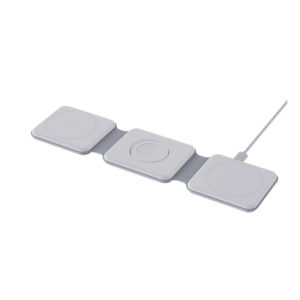 Which cable length should be bundled with a travel charger?
Most travel kits work best with a cable of roughly one metre, which reaches a bed or desk from a typical socket without taking too much space in the bag.
-
When should a charger have a captive cable instead of ports?
A built-in cable is convenient and ensures the right cable is always with the charger, so it suits travel chargers and single-device products.
-
How do we choose LED indicator colour and brightness for a wall charger?
Pick one clear, simple meaning, such as a single colour that shows the charger is powered or charging, keep the light dim enough for a dark bedroom and bright enough to see in daylight.
-
Which plug variants should a US-and-Canada charger range carry: two-pin, three-pin or both?
Most phone and laptop chargers sold in the US and Canada use a two-blade plug, because they are double-insulated and do not need an earth connection.
-
How should a charger’s surface finish (UV coating, spray, IMD) be chosen for a gift range?
Spray and UV coatings give a wide range of looks at moderate cost, but the coating can wear or chip.
-
What should a sliding multi-plug mechanism be tested for before volume production?
Test the mechanism for repeated use, locking strength, plug retention, drop and heat, and check that no live part is exposed in any position.
-
Which cable materials and colours (TPE, braided, silicone) suit a charger kit?
TPE is the standard, balanced choice: flexible, low cost and easy to colour.
-
What USB-C connector durability should we require, and how is it verified?
Ask for the durability figure in the USB Type-C specification as a minimum, and require the factory to show test results from a cycle test on samples of your actual part and cable.
-
Is a GaN travel charger with a folding plug worth the extra cost for customers?
A folding-plug GaN charger is worth the extra cost for customers who carry it often, such as commuters, travellers and laptop users, because it packs smaller and protects the bag.
-
What size and weight targets are realistic for a 65W GaN charger with a folding plug?
Do not guess a target.
-
Which charger shapes (cube, slim, folding) pack best into retail cartons?
A flat, slim charger usually gives the smallest retail box and the most efficient shipping, a cube is compact in two directions but deeper on a shelf, and a folding design packs flat but adds a hinge.
-
Why do some chargers include an earth pin, and when is a Class II design enough?
A charger with an earth pin relies on a protective earth connection to keep users safe if the insulation fails.
-
Should a travel kit include a pouch, and what should it be made of?
A simple pouch is usually worth adding to a travel kit, because it keeps small parts together and protects the charger from scratches.
-
Which plug-blade style (fixed, foldable, interchangeable) suits wholesale versus gift programmes?
Fixed blades are the cheapest, strongest and simplest, so they suit most wholesale volume.
-
How big is a 100W multi-plug travel charger compared with a standard laptop brick?
A GaN travel charger at 100W is usually noticeably smaller than a traditional laptop brick, but the saving depends on the plug mechanism, the number of ports and the cooling design.
-
What makes a wall charger tip out of a loose or worn socket, and how can the design reduce it?
A charger falls out when its weight and centre of gravity pull harder than the socket grips.
-
How do blade materials and plating affect wear and corrosion on plug pins?
Blade material sets strength and conductivity, and plating sets how well the pin resists corrosion and wear.
-
How wide should a charger body be so it does not block the neighbouring socket?
There is no single number. Test the body and plug position on the real outlets and power strips your customers use, and keep the body narrow where it sits beside the next socket.
-
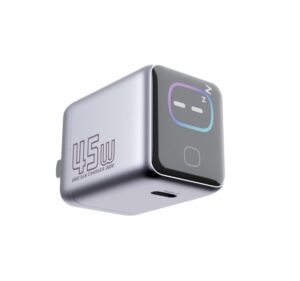
 Is a smart-screen display useful for business travellers?
Yes, for some. A display shows whether a laptop is getting enough power and which port is doing what, which helps with hotel sockets and shared chargers. It adds cost and a little light at night. Choose it for tech-savvy travellers who value feedback.
-
Is a foldable plug worth it on a 65W charger?
Foldable pins protect bags and other items, and make the charger easier to pack. They add some cost and a hinge to check. For travel and laptop users, foldable pins are usually worth it; for desk or hotel use, fixed pins are fine.
-
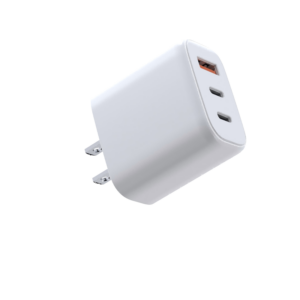 Which port layout should a travel charger have: 2C1A, 2C2A or 3C2A?
Match ports to the cables your customers actually carry and the devices they charge together. More ports means more power-sharing rules to explain.