
Wireless Charger
Everything that decides whether a wireless charger sells: the format, the alignment, the rate the phone actually gets, and what it costs to put your branding on it. WECENT builds the full range, from 200 pcs per model.
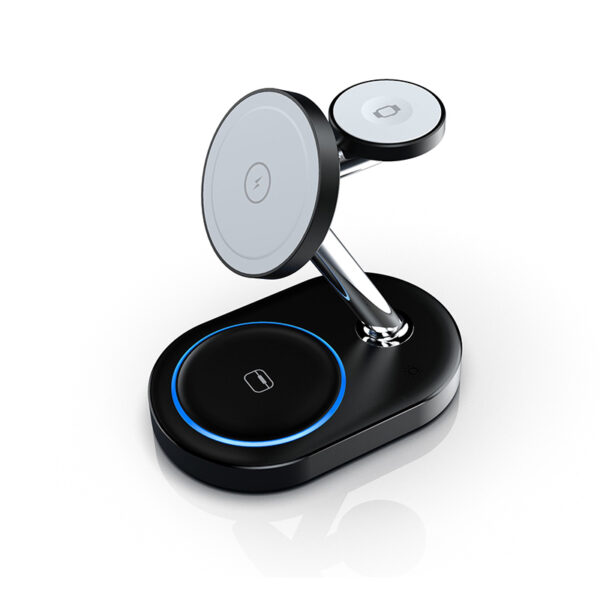
A wireless charger transfers power through a coil, so the phone only needs to be set down rather than plugged in. What separates one product from another is the format — pad, magnetic, stand or multi-device station — and the alignment, because a phone sitting off the coil centre charges slowly and runs hot.
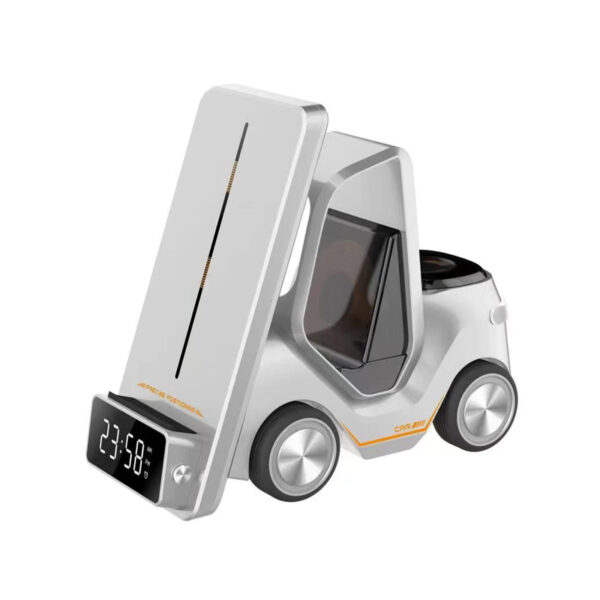
Three decisions decide a wireless charger
The first is where the charger lives. A bedside table, a desk and a hotel room ask for three different products, and picking the wrong one is the single most common reason a wireless SKU underperforms. The second is whether the target phones have a magnet ring: magnetic alignment makes the rated rate repeatable, while a free-position pad leaves it to the user. The third is the power budget — on a multi-device unit every coil draws from one input, so the simultaneous behaviour has to be designed rather than assumed.
Underneath all three sits the same engineering. A coil, a magnet array where it is magnetic, shielding so the field does not disturb the phone’s sensors, and a thermal path so the unit can hold its rate for hours rather than minutes. Those are the parts the customer never sees and the parts that decide whether the product gets a five-star review or a return.
- Where it lives. Pad for a phone that goes away, stand for a phone that keeps working, station for several devices.
- Alignment. Magnetic units hold the coil sweet spot; free-position pads cover older devices but depend on the user.
- Power budget. Every coil shares the input, so the adapter rating and the coil layout are specified together.
Which wireless charger format fits which job
The four formats in production cover almost every channel, and they can share the same coil and power stage — so the choice is about use, not electronics. The table is the short version; each format has its own page with the detail.
| What you are choosing | Pad / magnetic pad | Stand or multi-device station |
|---|---|---|
| Phone usable while charging | No — lies flat | Yes on a stand; several devices on a station |
| Cost and packed volume | Lowest — packs almost flat | Highest — the base sets the carton |
| Alignment | Magnetic pad solves it; free-position pads leave it to the user | Magnetic stand solves it; stations add fixed coils |
| Best channel | Gifting, in-box accessory, travel | Retail own-brand, office, hospitality |
Format detail: pad, magnetic, stand, 3-in-1, station, travel and desk.
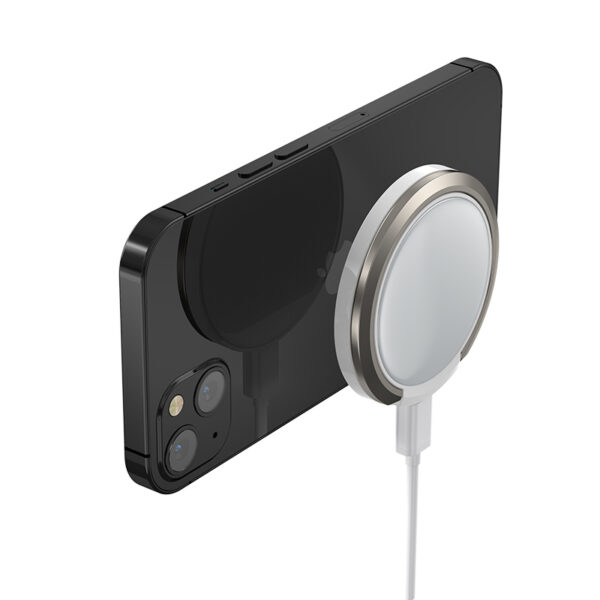
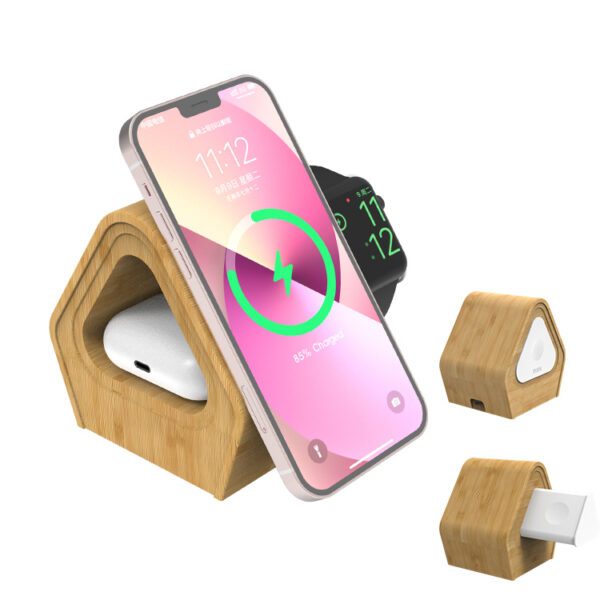
Putting your brand on a wireless charger
Because the electrical design stays fixed, branding a wireless charger is a surface and packaging exercise — which is what keeps the MOQ at 200 pcs and the sample at 2–3 days.
- Logo and printing — silk-screen, laser etching or UV printing on the shell or the contact face.
- Colour and material — black and white as standard, plus custom shell colour, wood, bamboo and PU leather faces.
- Packaging — colour box, insert and sleeve artwork, or neutral packing for private label.
- Bundle — cable, adapter or travel pouch quoted with the set so it ships retail-ready.
Wireless charger range — what we build
| Charging standard | Qi2 and MagSafe-compatible 15W platforms; legacy Qi profiles confirmed per model on the datasheet |
|---|---|
| Formats | Pad, magnetic pad, upright stand, 3-in-1 to 5-in-1 station, foldable travel unit, magnetic power bank |
| Coil layout | Single, twin or three-coil; phone plus watch and earbuds on one board |
| Alignment | Magnet array on magnetic models; free-position on non-magnetic pads |
| Housing and finish | ABS, PC, bamboo or wood face, PU leather, silicone; black and white as standard plus custom colour |
| Input | USB-C; adapter rating specified with the unit and quoted as a bundle where needed |
| Certifications | CE, RoHS, FCC, UKCA, PSE, KC, SAA and CB reports for a wireless charger, depending on the target market |
| MOQ | 200 pcs per model for a branded wireless charger; a trial quantity can be split across a few SKUs |
| Samples | 2–3 days with your logo and finish applied to the wireless charger |
| Mass production | 7–15 days after sample and artwork approval for the wireless charger |
| Carton | 50 pcs per carton as standard for the wireless charger, or customised to your requirement |
| Warranty | 2 years on the wireless charger, with a 24-hour complaint response and batch traceability |
The rows above describe a standard wireless charger. Custom power stages, coil layouts, plugs and packaging are quoted per project, and every figure is confirmed on the datasheet before a sample is built.
A wireless charger for every format
How a wireless charger is built and checked
Every format in the range — a flat pad and a five-coil station alike — passes the same seven gates in the same order, which is what makes a mixed range predictable to plan and to reorder.
Material preparation and checking
The coils, magnet arrays, shielding, housings and cables are checked against the approved bill of materials before a wireless charging pad reaches the line, so a substituted component cannot reach a shipment silently.
First-piece quality confirmation
The first pad or station of a run is built and charged against the approved sample before the line continues — coil position and hold force are confirmed here, not assumed from the drawing.
Assembly on static-protected lines
Boards are assembled on static-protected lines to a written operation sheet. On a magnetic wireless charger the magnet array and the coil are placed in one step, because the two decide each other.
Visual inspection rounds
Repeat inspections cover solder joints, coil seating, magnet placement, shielding and the cosmetic condition of the top surface — the face a customer looks at first.
Aging under load and electrical testing
Every unit runs an aging cycle under load and is re-measured afterwards, which is where a pad that looks fast on a bench but not in a sealed housing is caught.
Charging and protocol verification
Output voltage and current are measured across every coil, and the phone profile is checked for PD, PPS ranges, QC, AFC, FCP, Apple 2.4A and BC1.2 handshakes per family.
QA sampling, packing and shipment inspection
Sampling runs before packing, the colour box, insert and cable are checked against the approved artwork, and the batch report keeps each shipment traceable to its production run.
The inspection route does not change across the formats: a flat pad and a five-coil station pass the same gates, which is what makes a mixed range predictable to plan and to reorder.
Where a wireless charger gets specified
Retail own-brand
Your colour and box on a certified platform, sold as your SKU.
Corporate gifting
A branded pad or folding unit with a large print area and a low unit cost.
Hospitality and office
Stands and stations that remove cables from rooms and meeting tables.
In-box accessory
Sized and specified around the device it ships with.
Certifications and what comes with the shipment
The file for a wireless charger is assembled from the first sample rather than hunted down before dispatch, so the paperwork matches the market the container is going to.
CE / UKCA
European Union and United Kingdom market access for the finished unit and its power supply.
FCC
United States electromagnetic compliance for the finished unit.
RoHS / REACH
Restricted-substance documentation for the European market.
PSE / KC
Japan and Korea market documentation, quoted with the plug kit.
CB / SAA / GS / ETL
Additional reports quoted where the channel or retailer requires them.
ErP efficiency
Efficiency documentation for the EU external power supply regulation.
Reference standards behind this page: Wireless Power Consortium (Qi / Qi2), EU external power supply regulation (ErP), EU CE marking and the USB Implementers Forum for USB-C and Power Delivery specifications.
Every wireless charger format, explained
Wireless charger manufacturer
What to check before choosing a factory.
Magnetic wireless charger
Why alignment decides the real rate.
Wireless charging pad
The cheapest, flattest format.
Wireless charging stand
When the phone needs to stay readable.
3-in-1 wireless charger
Phone, watch and earbuds on one board.
Wireless charging station
Three to five devices from one base.
Qi2 chargers
The standard behind magnetic alignment, explained.
Multi-port chargers
Wired multi-port, and how the ports share one budget.
Wireless charger — FAQs
How fast is a wireless charger?
Our platforms run at the Qi2 and MagSafe-compatible 15W band, which is the highest standardised wireless rate. The rate the phone actually receives depends on alignment, case thickness and heat, which is why a magnetic pad typically holds a higher rate for longer than a free-position one.
Which wireless charger format should I choose?
Start from where it lives. A pad for a phone that goes away, a stand for a phone that keeps working, a station for several devices, and a foldable unit for travel. All four can share the same coil and power stage, so the decision is about use rather than electronics.
Do magnetic wireless chargers need a special phone?
They need a phone with a magnet ring or a MagSafe-compatible case to snap into alignment. Phones without one can still charge on the coil but will not align themselves — for a mixed fleet, a free-position pad is often the safer choice.
Can it charge through a case?
MagSafe-compatible cases pass the field; thick or metal-backed cases reduce it. A card holder or metal plate behind the phone usually prevents wireless charging entirely.
What does a wireless charger cost to build?
More than a wired charger of the same output, because of the coil, the magnet array and the shielding. Unit cost falls with volume, and the tooling and printing plates are quoted separately — the tooling note explains the lines.
What is the minimum order?
200 pcs per model across the range, from a single pad to a five-coil station, and a trial quantity can be split across formats so the first order tests two placements rather than one product.
How long do samples and production take?
Samples ship in 2–3 days with your logo and finish applied; mass production runs 7–15 days after sample and artwork approval.
Which certifications come with it?
CE, RoHS, FCC, UKCA, PSE, KC, SAA and CB reports depending on the target market, assembled from the first sample rather than before dispatch.
Does it include the adapter?
It can ship unit-only or with the cable and adapter it needs. The adapter rating sets the ceiling for every coil, so it is specified with the unit rather than added later.
What happens if a unit fails?
Two years on the platform, with a 24-hour first response and batch traceability. What the complaint comes back as depends on the format — a surface issue on a pad, a hinge issue on a folding unit, a thermal issue on a station — which is why the batch record is kept per configuration.
Do wireless chargers work on any phone?
Any phone with a wireless receiver charges on the coil, at the rate it negotiates. Magnetic products additionally snap phones with a magnet ring into the coil centre. The two things that stop it working are a phone without a receiver and a case or card holder that shields the coil.
What is the downside of wireless charging?
It is slower than a cable and it loses more energy in the transfer, which shows up as heat. Both are manageable: a magnetic platform holds the coil centred so the loss stays low, and a phone that is exposed to air — on a stand rather than a pad — runs cooler than one lying flat.
What is the best wireless phone charger?
The format decides it. A pad if the phone goes away while charging, a stand if the screen has to stay readable, a station if several devices charge in one place, a folding unit if it travels. Once the format is right the electronics are broadly equivalent across the range.
Wireless chargers in more detail — phone compatibility, formats, wattage and OEM supply Know more Know less
Which phones charge on a wireless charger
Any phone with a wireless charging receiver charges on a wireless charging pad, at whatever rate the phone and the pad negotiate between them. The receiver is built into the phone, so there is nothing to plug in — the phone only has to sit over the coil.
Magnetic alignment is a separate feature. Apple introduced a magnet ring with the iPhone 12 generation, and Qi2 uses the same magnetic reference, so an increasing number of Android models support it too. For a phone without a ring, a MagSafe-compatible case or a stick-on ring supplies one. Without it the phone still charges, but the user has to find the coil centre by hand.
Qi wireless charger, Qi2 and MagSafe — the naming
Qi is the baseline standard: any compatible phone charges. Qi2 adds a magnetic alignment reference to that standard, which is why Qi2 units behave consistently across brands. MagSafe is Apple’s implementation of magnetic alignment, and a MagSafe-compatible accessory works with phones that carry a ring.
In a product listing these three names get used loosely. The specification that matters is the one on the datasheet: which band the platform negotiates, how many coils it has, and whether a magnet array is fitted.
Formats: pad, magnetic pad, stand, 3-in-1 and multi-device station
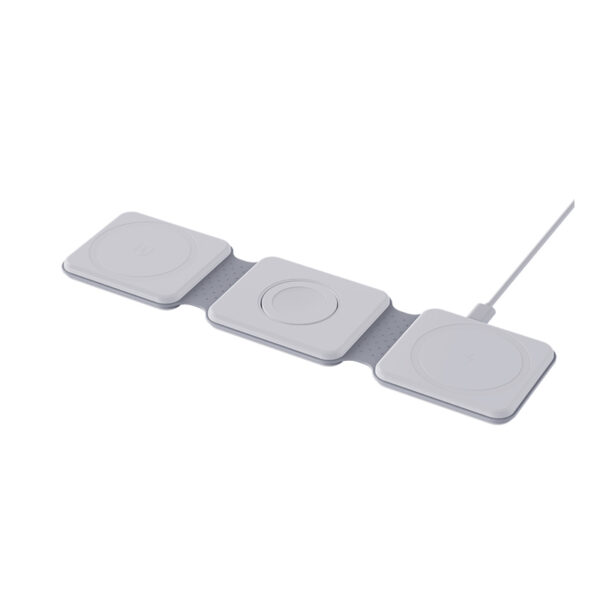
A flat pad is the lowest-cost format and the largest branding surface, and the phone lies face-up while it charges. A magnetic pad adds alignment and holds the rated rate. A stand keeps the phone upright so the screen stays readable, which is the bedside and desk case. A 3-in-1 board charges a phone, a watch and earbuds from one cable, and a multi-device station is the same idea at the scale of a shared desk or a hotel room.
All four can share one coil and one power stage, so a range can carry several formats without new electronics — which is what keeps samples fast and the MOQ at 200 pcs per model.
Wattage: wireless bands and when 20W means wired
The standardised wireless charging bands run to 15W, and that is what a Qi2 or MagSafe-compatible platform delivers. Figures above that come from vendor-specific fast-charge profiles that only some phone families negotiate, so a 20W wireless claim has to be tied to named devices rather than printed on a box for everyone.
A 20W wired USB-C charger is the other answer to the same brief: it delivers the full 20W to any USB-C phone, at a lower unit cost.
Buying wireless chargers wholesale, OEM or private label
Wholesale orders start at 200 pcs per model and can be split across a few SKUs. OEM means the product is built to your specification on top of a platform that already holds its test reports; private label means the same platform ships under your brand with your packaging and no visible reference to the original model.
Either way, send the phone list, the form factor you want, the markets and the quantity. You get pricing, lead time and the certification list for those markets — and a plain answer if a magnetic product is the wrong choice for the devices involved.
The names people use for the same product
The same product is searched for as a wireless charger, a charging pad, a charging stand, a charging station or a device charger station, and the difference between them is the format rather than the technology: a pad lies flat, a stand holds the phone upright, a station carries several coils. Induction charging is the older term for the same mechanism.
What decides the outcome is not the name on the box but the format and the alignment — which is why the format pages on this site are organised the way they are.
Send your spec, get a costed quotation
Tell us the format, the devices and the markets. You get unit pricing at your quantity, the sample date and the certification list per destination — and if a wired charger is the better product for the brief, we will say so.
- MOQ from 200 pcs per model, splittable across a few SKUs
- Samples in 2–3 days with your logo and finish applied
- Reply within 24 hours on business days