
Wireless Charging Station
A wireless charging station charges three to five devices from one base and one cable — phone, watch, earbuds, and on the larger formats a second phone or a tablet stand. WECENT builds them from 200 pcs per model.
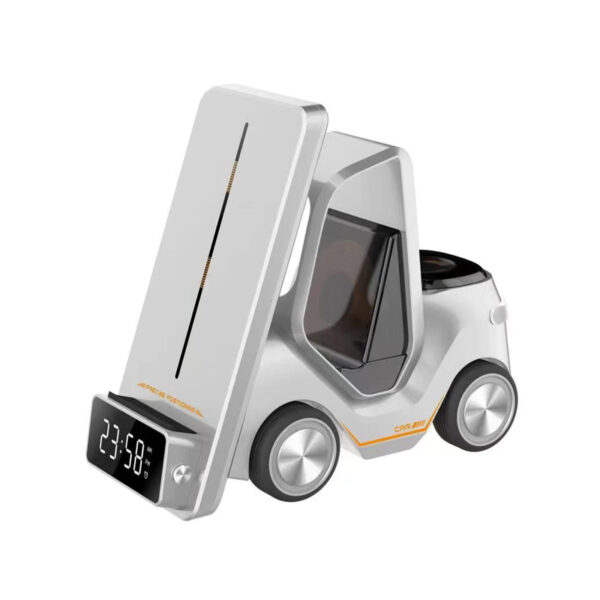
The number that decides a station is not the coil count but how many devices charge at once: every coil draws from the same input, so the phone takes the large share while the watch and earbuds trickle. Size the base to the devices that are actually there — 3-in-1 for one person, 5-in-1 for a shared desk or a hotel room.
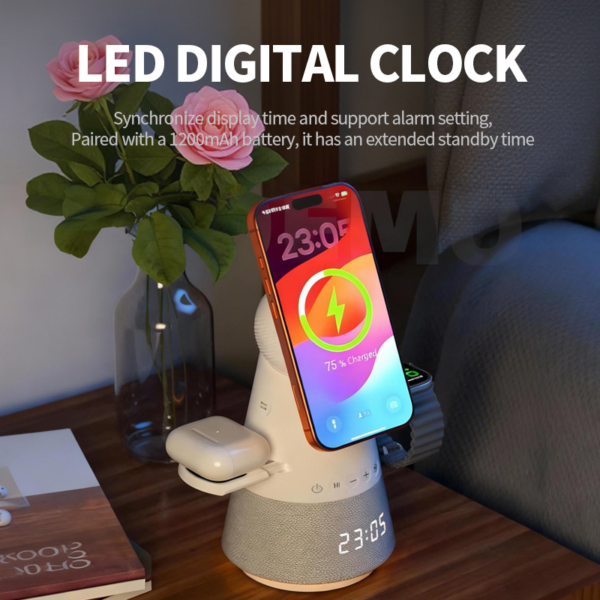
A station is a power-budget problem before it is a design problem
Every coil on the base draws from the same input, so a station is really a power allocation decision. The phone takes the large share, the watch and earbuds trickle, and a second phone or a tablet stand splits whatever is left. That is fine — watches and earbuds need very little — but it has to be designed deliberately rather than discovered when the first sample runs hot.
Heat is the other half. Coils that sit close together share a thermal envelope, and a station with no air gap and no thermal path behaves very differently at hour three than at minute three. On the larger formats the base itself is part of the cooling design, which is why a 5-in-1 station is heavier and more expensive than the sum of its coils.
- Input and allocation. The adapter rating sets the ceiling for everything on the base, so it is specified with the station rather than added later.
- Coil spacing. Coils that are close together need shielding and a thermal path, not just a bigger enclosure.
- Which devices are simultaneous. Designing for three devices at once and designing for five are different briefs.
3-in-1, 4-in-1 or 5-in-1?
More coils sound like strictly more value and they are not. Each additional device adds footprint, cost, carton volume and a share of the power budget. The right station is the one that matches what the customer actually owns: most people carry one phone, one watch and one set of earbuds, which is a 3-in-1. The 4-in-1 and 5-in-1 formats are for shared spaces — hotel rooms, meeting rooms, family desks — where more than one person or device is charging at once.
| What you are choosing | 3-in-1 station | 4-in-1 / 5-in-1 station |
|---|---|---|
| Devices covered | Phone, watch, earbuds | Adds a second phone or a tablet stand |
| Typical place | Bedside table, personal desk | Hotel room, meeting room, family desk |
| Footprint and carton | Compact | Substantially larger base |
| Unit cost | Lower | Higher — more coils, more shielding, more mass |
The 3-in-1 format is covered in more detail on the 3-in-1 page, and desk-specific choices are on the desk charger page.
What you can change on a station
Everything below is applied on top of a platform that is already tested, which keeps the sample at 2–3 days and the MOQ at 200 pcs per model.
- Number and layout of coils — 3, 4 or 5 devices, with the coils positioned for your target devices.
- Base and materials — weighted base, ABS or PC shell, bamboo or wood face, PU leather contact surfaces.
- Extras — speaker, clock or ambient lighting where the channel wants a desk feature rather than a plain charger.
- Logo and packaging — printing on the base and the box, plus inserts sized for the station.
Wireless charging station — specifications
| Charging standard | Qi2 and MagSafe-compatible 15W on the phone coil; other coils confirmed per model on the datasheet |
|---|---|
| Device count | 3-in-1, 4-in-1 and 5-in-1 layouts in production |
| Coil layout | Phone, watch, earbuds, plus a second phone coil or tablet stand on larger formats |
| Power allocation | Shared across coils; the simultaneous behaviour is stated per model rather than assumed |
| Base | Weighted base with grip; base mass confirmed per model |
| Extras | Speaker, clock or ambient lighting quoted as options |
| Input | USB-C; the adapter rating is specified with the station and quoted as a bundle where needed |
| Certifications | CE, RoHS, FCC, UKCA, PSE, KC, SAA and CB reports for a multi-device charging station, depending on the target market |
| MOQ | 200 pcs per model for a branded multi-device charging station; a trial quantity can be split across a few SKUs |
| Samples | 2–3 days with your logo and finish applied to the multi-device charging station |
| Mass production | 7–15 days after sample and artwork approval for the multi-device charging station |
| Carton | 50 pcs per carton as standard for the multi-device charging station, or customised to your requirement |
The rows above describe a standard multi-device charging station. Custom power stages, coil layouts, plugs and packaging are quoted per project, and every figure is confirmed on the datasheet before a sample is built.
Station platforms in production
R10 5-in-1 with speaker
Five devices plus a Bluetooth speaker and clock — a desk feature.
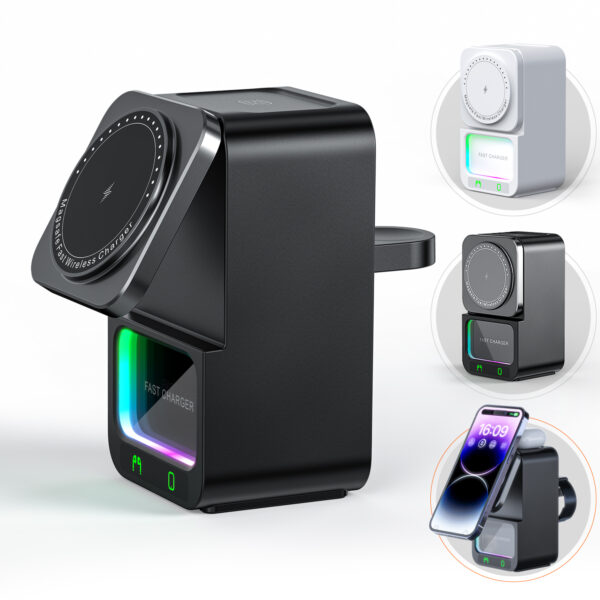
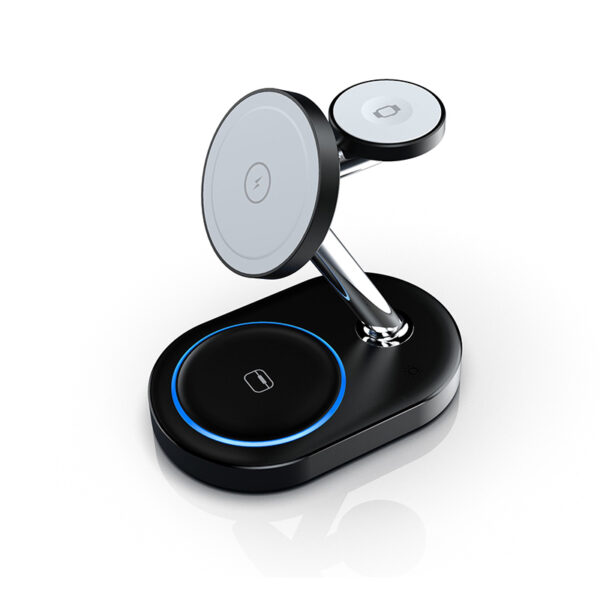
How a multi-device charging station is built and checked
On a station the aging gate is run with several coils active at once, because that is where a shared thermal envelope reveals itself.
Material preparation and checking
Every coil, the watch puck, the shielding, the weighted base and the adapter that will power the station are checked against the approved bill of materials together.
First-piece quality confirmation
The first station of a run is built and charged with several devices at once before the line continues, because the interesting behaviour only appears under that load.
Assembly on static-protected lines
Boards are assembled on static-protected lines to a written operation sheet, with coil spacing and shielding verified against the approved layout rather than by eye.
Visual inspection rounds
Repeat inspections cover coil position on each position, spacing between coils, base mass, grip and the finish of the top surface.
Aging under load and electrical testing
Aging runs with multiple coils active at the same time and the units are re-measured afterwards — this is the gate that exposes a shared thermal envelope.
Charging and protocol verification
Output voltage and current are measured on every coil while the others are running, so the behaviour a multi-device charging station actually delivers is recorded rather than assumed.
QA sampling, packing and shipment inspection
Sampling runs before packing, the box and insert are checked against the approved artwork, and the batch report ties a coil or allocation issue back to a production run.
On a station the interesting test is the sustained one: units run the aging cycle with several coils active at once, because that is where a shared thermal envelope shows up.
Where a charging station gets specified
Hotel rooms
One base for a guest’s phone, watch and earbuds — fewer cables to replace and fewer support calls.
Meeting and shared desks
Several people charging at once without a cable fight.
Retail own-brand
A flagship SKU in the range, in your colour and box.
Family and home office
Two phones and a watch on one bedside table.
Certifications and what comes with the shipment
The file for a multi-device charging station is assembled from the first sample rather than hunted down before dispatch, so the paperwork matches the market the container is going to.
CE / UKCA
European Union and United Kingdom market access for the finished unit and its power supply.
FCC
United States electromagnetic compliance for the finished unit.
RoHS / REACH
Restricted-substance documentation for the European market.
PSE / KC
Japan and Korea market documentation, quoted with the plug kit.
CB / SAA / GS / ETL
Additional reports quoted where the channel or retailer requires them.
ErP efficiency
Efficiency documentation for the EU external power supply regulation.
Reference standards behind this page: Wireless Power Consortium (Qi / Qi2), EU external power supply regulation (ErP), EU CE marking and the USB Implementers Forum for USB-C and Power Delivery specifications.
Related guides and platforms
Wireless charging stands
Upright formats for bedside and desk use.
Wireless charging pads
The simplest, lowest-cost format — and where it wins.
Choosing a desk charger
Footprint, cable and heat compared across the three formats.
3-in-1 wireless chargers
The personal-scale version of a station.
Wireless charger applications
Desk, hotel, retail and gift channels.
Wireless charger manufacturing
What to check before choosing a factory.
Multi-port chargers
The same shared-budget question, with cables.
Wireless charging station — FAQs
Do all the devices charge at full speed at the same time?
No, and no station does. The coils share one power budget, so the phone takes the large share while the watch and earbuds trickle — which matches what those devices need. If a programme needs a higher simultaneous rate, that has to be designed in before the sample.
How many devices should a station charge?
Match it to what the customer owns. Most people carry one phone, one watch and earbuds, which is a 3-in-1. The 4-in-1 and 5-in-1 formats are for shared spaces where two people or several devices charge at once.
Does the station come with its own adapter?
It can ship unit-only or with the adapter the station needs. The adapter rating sets the ceiling for every coil on the base, so the two are specified together rather than separately.
Will it get hot?
Heat is the design constraint on a multi-coil base: coils close together share a thermal envelope. That is why the larger formats use a heavier base and why the behaviour is measured over a sustained run rather than at minute three.
Can I choose which devices it charges?
Yes. The coil layout is part of the specification — a second phone coil and a tablet stand are options on the larger formats, and the watch puck can be fixed or hinged.
What is the minimum order?
200 pcs per model covers a branded station. Because a 5-in-1 base is a heavier item to tool and pack, the trial quantity is often split between a 3-in-1 and a larger format so the first order tests two room sizes rather than one.
How long do samples take?
2–3 days with your logo and finish applied. Mass production runs 7–15 days after sample and artwork approval.
Which certifications apply?
CE, RoHS, FCC, UKCA, PSE, KC, SAA and CB reports depending on the target market, with ErP efficiency documentation where the unit includes a power supply.
Can the base carry our logo?
Yes — the top surface and the front face are both available for printing, laser etching or UV printing, and the box can be drawn to your artwork.
What is the warranty?
Two years, with the multi-coil board and the base covered together. Batch traceability matters more on a station than on a single pad, because a thermal or allocation issue affects a production run rather than an individual unit, and the batch report shows which one.
Is a wireless charging station worth it?
It is worth it when more than one device charges in the same place — a phone, a watch and earbuds at a bedside, or two phones on a shared desk. It replaces three cables with one, and the cost is footprint: the base takes real desk or table space, which is the trade you are making.
Does a wireless charger work with any phone?
Any phone with a wireless receiver charges on the coil, at the rate it negotiates. Magnetic alignment only applies to phones with a magnet ring. On a station that matters more than on a single pad, because one of the slots may hold an older device that needs free positioning.
What’s the best wireless charging station?
The one that matches the devices that are actually there. Coils are cheap to add and expensive to carry: every extra slot adds footprint, cost and a share of the power budget. Matching the station to the real device count is what makes it feel considered rather than oversized.
Wireless charging stations in more detail — device count, power sharing and sourcing Know more Know less
A multiple device charging station — 3-in-1, 4-in-1 and 5-in-1
A multiple device charging station puts several coils on one base so that phones, a watch and earbuds charge from a single cable and a single socket. The same product is sold as a charging dock, a charging hub or a charging stand depending on the channel, and the coils are what decide the behaviour rather than the name. A 3-in-1 covers one person’s phone, watch and earbuds; a 4-in-1 adds a second phone coil; a 5-in-1 adds a tablet stand or a third phone position.
A wireless charging station for multiple devices should be sized to the devices that are actually there. Each additional coil adds footprint, cost and a share of the power budget, and an oversized base is a product that looks considered for a week and clumsy afterwards.
How the power is shared across the coils
Every coil on a station draws from the same input, so the phone takes the large share while the watch and earbuds trickle — which is what those devices need. A higher simultaneous rate is a design decision made before the sample, not a setting that can be switched on later.
That is why the adapter rating is specified with the station. Dropping a five-coil base onto a weak adapter does not break it; it simply holds a lower band and runs warmer.
Where charging stations are sold
Hotel rooms, shared desks and meeting rooms are the natural applications, because one base removes three cables and reduces the support calls that come with them. Retail own-brand ranges use a station as the flagship SKU above the pads, and gifting programmes sometimes use a 4-in-1 as a desk upgrade.
The variants that matter by channel are the base colour, whether a speaker or clock is fitted, and whether the box is drawn for retail or for a hotel fit-out.
Sourcing a multi-device charging station
Tell us how many devices the multi-device charging station has to hold, in what setting, and what the adapter can supply. You get a coil layout, a sample date and pricing at your quantity.
Orders start at 200 pcs per model, and the trial quantity can be split across two formats — often a 3-in-1 and a larger 5-in-1 — so the first order tests two room sizes rather than one. Certification covers the whole assembly including the adapter when it ships as a set, so the file matches what a reviewer opens in each market.
What a station is called in a listing
A station is listed as a multiple device charging station, a multi device charger station, a charging dock or a charging hub depending on the channel, and the search terms follow the listing rather than the product. The specification is the same in every case: how many coils, how much input the base needs, and how the load is shared when several devices are attached at once.
Send your spec, get a costed quotation
Tell us how many devices have to charge at once, in what setting, and what the desk or room can take. You get a coil layout, the adapter rating it needs and pricing at your quantity.
- MOQ from 200 pcs per model, splittable across a few SKUs
- Samples in 2–3 days with your logo and finish applied
- Reply within 24 hours on business days