
Talk · Selection · Travel plugs, form factor & materials
How wide should a charger body be so it does not block the neighbouring socket?
There is no single number. Test the body and plug position on the real outlets and power strips your customers use, and keep the body narrow where it sits beside the next socket.
 Wecent Editorial Team
Updated
3 min read
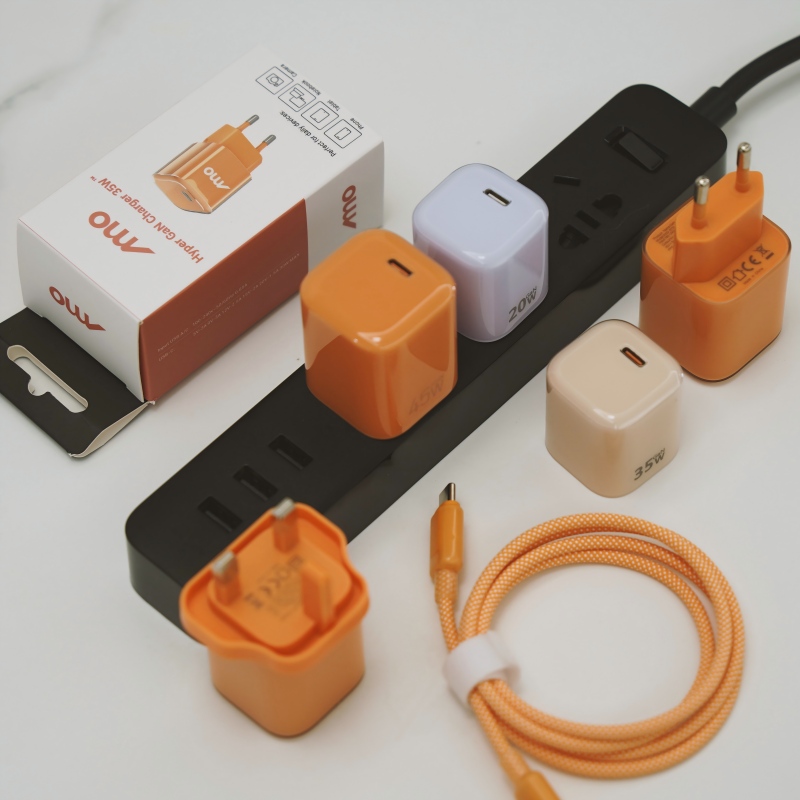
Reviewers of our competitors’ chargers often say ‘it blocks the other outlet’. We are specifying a new 65W wall charger. How wide and thick should the body be, and how do we test it?
Short answer: There is no universal safe number, because outlets, wall plates and power strips vary. What matters is how far the body extends sideways from the plug blades and how much it protrudes from the wall. Define a test fixture from the real outlets your customers use and make width and thickness pass criteria, not afterthoughts.
What blocks a neighbouring socket
Three things decide it: how wide the body is, where the plug blades sit on the body, and how thick the charger is from the wall. A charger with the blades near one edge extends further on the other side. A tall charger can also block a second socket above or below on a vertical outlet.
Why GaN helps and does not solve it
GaN designs allow smaller bodies for the same wattage, so there is more room to be narrow. But size is still a design decision. A small charger with an awkward layout can block a socket more than a larger charger with a well-placed plug.
Decisions to make early
- Blade position. Centred blades give a symmetrical footprint. Off-centre blades can leave one side free for the neighbouring socket.
- Orientation. Decide whether the charger sits upright or on its side on a typical outlet, and design the width for the less forgiving case.
- Thickness. Keep the depth low where it matters. A thin body fits behind furniture and in tight spaces.
- Port side. Ports on the bottom or side change how the cable leaves the body and what it touches.
How to build a test fixture
- Collect the outlets your customers use: standard wall outlets, outlets with different cover plates, and common power strips with the sockets close together.
- Measure the centre-to-centre spacing of the sockets and the clearance around them.
- Place a sample charger in one socket and try to use the neighbouring socket with a typical plug of another charger.
- Record pass or fail and take photos for the product specification.
What to put in the specification
Write the maximum width and depth as measured on the test fixture, not just the nominal body size. Add a note about plug position. Ask the factory to measure on the production sample as well as the engineering sample.
Listing wording
Only claim that a charger “does not block adjacent outlets” if you have tested it on the outlets customers use. A statement that holds for one outlet type and fails for another invites negative reviews.
Where this answer says to confirm with Wecent, the detail is not published on the product page and has to come from the datasheet or the factory. General facts come from the regulators, standards bodies or device makers named in the text.
Three more perspectives
Products discussed in this thread

Related articles & topics
Have a sourcing question about your own programme?
Ask our team More Travel plugs, form factor & materials questions