
Talk · Selection · Wired GaN chargers: wattage, ports & protocols
Is a 240W USB-C charger useful for anything today?
240W is the top of USB PD 3.1, but few devices draw it. Its value today is mostly multi-device desks, high-power laptops and headroom.
 Wecent Editorial Team
Updated
3 min read
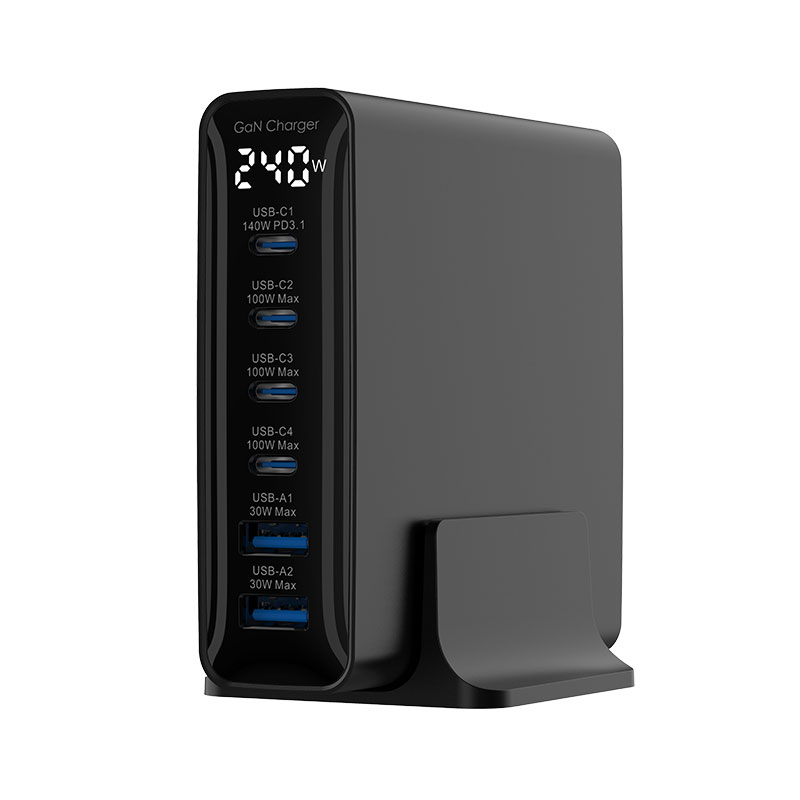
Wecent offers a custom 240W charger (WEG-240). Our marketing team loves the number. Is there a real use case today, or are we better off with 140W?
Short answer: Few devices draw anywhere near 240W over USB-C today. USB PD 3.1 allows up to 240W (48V at 5A), but most laptops draw 140W or less. A 240W multi-port charger is mainly useful as a desk hub, powering a laptop and several devices at once, or for the small number of high-power laptops that accept EPR above 140W.
What 240W means in USB PD
USB PD 3.1 added Extended Power Range voltages of 28V, 36V and 48V. At 48V and 5A, a single port can deliver 240W. That requires a 240W-rated EPR cable and a device that negotiates 48V. On a multi-port charger, “240W” can also be a total across ports, with a lower single-port maximum. Check the datasheet for which it is.
Which devices use it
- Most ultrabooks and many 14-inch laptops use 65–100W.
- Apple lists 140W for fast charging the 16-inch MacBook Pro.
- A few high-power laptops accept higher EPR levels; check each model’s documentation.
- Phones, tablets and accessories each take a small fraction.
Where 240W fits
- Desk hubs: a laptop plus monitor-powered accessories, phones and tablets from one charger, without sharing dropping the laptop below its needs.
- Two laptops: sharing between two 100W-class laptops.
- Headroom: buyers who want to stay ahead of future devices.
Trade-offs
- Size and weight: a 240W unit is a desk product, not a travel product.
- Price per unit is higher than 140W.
- Cables: full single-port power needs EPR cables; most users don’t own one.
- Claims: “240W” on the box can lead customers to expect 240W into one device, which their device may not accept.
Heat and placement
A charger delivering close to its full output converts some power into heat, and a 240W unit has much more to dissipate than a 65W one. Desk chargers at this level need open air around them, and some designs reduce output when they get warm. Check the thermal derating behaviour in the datasheet.
How to decide
Choose 240W for a desk or multi-device positioning, with the port table clearly stated. For a laptop-plus-phone travel or everyday SKU, 140W usually serves customers better. Confirm the WEG-240’s single-port maximum and port combinations with Wecent before writing the listing.
Where this answer says confirm with Wecent, the detail is not published on the product page and has to come from the datasheet or the factory. General facts come from the standards bodies, regulators or device makers named in the text.
Three more perspectives
Products discussed in this thread
Related articles & topics
Have a sourcing question about your own programme?
Ask our team More Wired GaN chargers: wattage, ports & protocols questions