
The counterintuitive part of an e-marker cable is that the chip carries no power. It carries a description, and the description is what allows the device at the other end to accept current it would otherwise refuse.
E-marker cable: what the identification changes
It changes the tier the device will negotiate.
A cable with the marker fitted can be read by the device, which then negotiates the higher current the conductor is rated for. Without it, the same cable can still pass current, but the device treats it as an unknown accessory and settles at a lower level. The cable is not broken; it is simply not recognised.
What the marker actually is
One component inside the connector, on one of the wires.
It is a small electronic element assembled into the connector shell during the moulding step, powered from the cable’s own signalling line. Because it sits inside the assembly, it is invisible from outside, which is why a cable that carries it and one that does not look identical in the hand and on a photograph.
What it changes in the negotiation
Three outcomes, and the third is the one customers notice.
The device reads the description, accepts the higher current, and the negotiated tier holds for the session. Where the marker is present but the conductor gauge is short, the device may still settle lower because the voltage drop tells it the same story. Where the marker is absent, the negotiation stops before the drop is even measured.
What it does not change
Four things it does not do.
It does not increase the conductor’s current capacity, it does not improve the connector’s mechanical life, it does not shield the cable from interference, and it does not make a long cable behave like a short one. Each of those is a construction decision, and the marker is a description of the construction rather than a substitute for it.
Which devices read it
The ones that negotiate at the higher tiers.
Devices that draw at the lower levels commonly ignore the marker, because the negotiation settles before the question arises. Laptops, monitors and the higher-power accessories are the products where the marker matters, because they are the ones that change what they accept based on what the cable reports.
| Element | What it decides | Effect of its absence | Effect of its presence |
|---|---|---|---|
| Identification component | What the device will consider | The device settles lower | The tier can be offered |
| Conductor gauge | Voltage drop over the length | The tier is offered and lost | The tier is held |
| Connector retention | The link staying seated | Intermittent charging | A stable session |
| Strain relief | Field life at the connector | Returns at the plug | Cycle life to specification |
Where the claim goes wrong
Three patterns, and the second is the one that reaches customers.
A cable sold as marked when the component was omitted from the assembly; a cable marked and rated on the pack while the conductor is below the gauge the rating assumes; and a cable whose marking is correct but whose tests were performed on a prototype rather than the production assembly. Each is settled by measuring a sample rather than by reading a datasheet.
What to verify before ordering
Four items, and the first is written rather than measured.
The gauge and length stated in the specification, the identification confirmed as present in the production assembly, the negotiated tier measured at the far end of a production sample, and the test records for the voltage drop. Those four are the comparison basis between two cable suppliers.
Question: is the marker always required?
Only where the programme claims the higher tier.
A cable supplied with a low-power accessory does not need the marker, because the negotiation settles before it is consulted. The decision follows the claim on the packaging rather than the cable’s own construction, which is why the specification starts from the tier the product promises.
FAQ
Can a cable without the marker be upgraded later?
Not by a firmware change, because the component sits inside the moulded connector and cannot be added to a finished assembly. A cable programme that may need the higher tier later specifies the connector with the component from the start, and the cost of doing so at that stage is far smaller than a moulding revision.
Does the marker make a cable safe at higher current?
It makes the cable recognisable, which is a different thing from making it capable. Safety at the current follows the conductor gauge, the insulation and the connector’s rating, and a cable that reports a tier its construction cannot carry is a worse outcome than one that never reported it.
How is the negotiated tier measured?
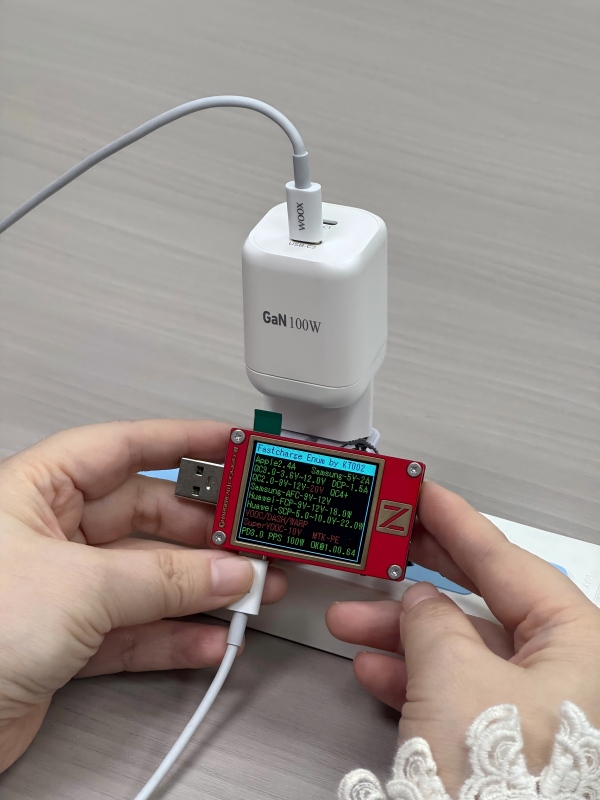
By connecting the production cable between a known charger and a device or a test instrument that records the negotiated level, and reading the result rather than the marking. The measurement takes minutes and it covers the connector, the component and the conductor in one number.
Why does the same cable behave differently on two devices?
Because the two devices ask for different things: one may never request the higher tier, and the other may request it and then reduce after reading the voltage drop. The device list therefore belongs in the cable specification, and a claim is written against the devices it was measured with.
Next step
Send the device list, the tier you claim and the cable length to Wecent Group through the contact page. The reply sets out the assembly, the gauge and the measured tier. Related reading: charger manufacturing services, charger quality control and OEM and ODM charger manufacturing. External references: USB Implementers Forum charger specification, USB-IF document library, USB-IF compliance programme, IEC standards, BSI standards and UL solutions.
{“@context”:”https://schema.org”,”@type”:”FAQPage”,”mainEntity”:[{“@type”:”Question”,”name”:”Can a cable without the marker be upgraded later?”,”acceptedAnswer”:{“@type”:”Answer”,”text”:”Not by a firmware change, because the component sits inside the moulded connector and cannot be added to a finished assembly. A cable programme that may need the higher tier later specifies the connector with the component from the start, and the cost of doing so at that stage is far smaller than a moulding revision.”}},{“@type”:”Question”,”name”:”Does the marker make a cable safe at higher current?”,”acceptedAnswer”:{“@type”:”Answer”,”text”:”It makes the cable recognisable, which is a different thing from making it capable. Safety at the current follows the conductor gauge, the insulation and the connector’s rating, and a cable that reports a tier its construction cannot carry is a worse outcome than one that never reported it.”}},{“@type”:”Question”,”name”:”How is the negotiated tier measured?”,”acceptedAnswer”:{“@type”:”Answer”,”text”:”By connecting the production cable between a known charger and a device or a test instrument that records the negotiated level, and reading the result rather than the marking. The measurement takes minutes and it covers the connector, the component and the conductor in one number.”}},{“@type”:”Question”,”name”:”Why does the same cable behave differently on two devices?”,”acceptedAnswer”:{“@type”:”Answer”,”text”:”Because the two devices ask for different things: one may never request the higher tier, and the other may request it and then reduce after reading the voltage drop. The device list therefore belongs in the cable specification, and a claim is written against the devices it was measured with.”}}]}