
Talk · Selection · Wireless, magnetic & multi-device
How does a wireless charger work, and what decides how fast it charges?
A wireless charger moves power between two coils through a changing magnetic field. Alignment, the power source and the phone decide the speed.
 Wecent Editorial Team
Updated
3 min read
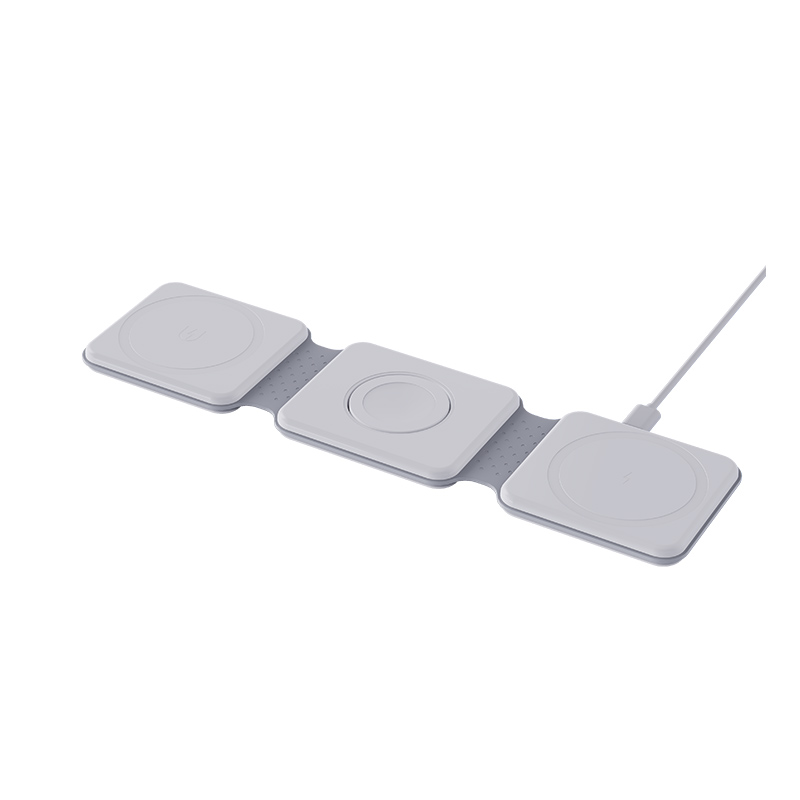
Shoppers and support teams keep asking the same thing: there is no cable, so how does power get into the phone, and why does the same pad charge one phone faster than another? We want a plain explanation we can reuse in our product guides.
Short answer: A wireless charger has a transmitting coil in the pad and a receiving coil in the phone. Alternating current in the pad coil creates a changing magnetic field, which induces current in the phone’s coil. The phone turns that into battery charge. Speed depends on coil alignment, the adapter feeding the pad, the phone’s own limits and anything between the two coils.
The basic principle
Apple’s support page describes wireless charging as using magnetic induction. The pad contains a coil driven by alternating current. That current produces a changing magnetic field. A second coil inside the phone sits in that field, and the field induces a current in it. The phone’s charging circuit converts this into direct current for the battery. The two coils never touch, which is why the gap between them matters so much.
How the phone and pad talk to each other
Qi, the open standard created by the Wireless Power Consortium, adds a communication layer. The phone tells the pad how much power it wants, and the pad adjusts. The pad also checks what is sitting on it. If it detects a metal object such as a coin or key rather than a phone, it can reduce power or stop, because metal heats up in a magnetic field. This is called foreign object detection, and good designs treat it as a safety feature, not an extra.
What decides the speed
- Alignment. Power transfer falls quickly when the coils are off-centre. Magnetic chargers use a ring of magnets to hold the phone in the right place every time, which is a big reason they are more consistent.
- The adapter. A pad can only pass on what its power source provides. Apple states that its MagSafe Charger needs a suitably rated USB-C adapter to reach its faster charging levels, and that power varies by iPhone model and conditions.
- The phone. Every phone has its own maximum wireless charging rate, and it can lower it when the battery is warm or nearly full.
- What is in between. Apple advises removing thick, metal or battery cases if charging is slow, and warns that magnetic mounts or cards placed between phone and charger can reduce performance.
Why wireless is usually slower than a cable
Some energy is lost as heat in the coils and electronics, and the gap and alignment add further loss. That heat is also why phones may slow charging when they warm up. This is normal behaviour, not a fault, though a pad that runs very hot or stops often deserves a closer look.
What to tell customers
Use a proper adapter, centre the phone or use a magnetic model, take thick cases off when testing, and keep metal objects away. For a deeper look at the standards behind this, see our guide on wireless charging standards.
Sources checked on 24 Oct 2026: Apple Support: How to wirelessly charge your iPhone; Wireless Power Consortium: Qi.
Where this answer says to confirm with Wecent, the detail is not published on the product page and has to come from the datasheet or the factory. General facts come from the regulators, standards bodies or device makers named in the text.
Three more perspectives
Products discussed in this thread
Related articles & topics
Have a sourcing question about your own programme?
Ask our team More Wireless, magnetic & multi-device questions