
A stand was returned because it tipped forward when a large phone was placed on it. The coil was correct, the alignment was correct and the electronics measured inside every limit; the base was not heavy enough for the moment that phone applied at that angle. The format decision had been taken as a styling question, and on a stand the format is a mechanical one.
Wireless charging stand manufacturer programmes: the five decisions
Five decisions fix a stand. Five decisions fix a stand: the viewing angle, the coil arrangement, the base and joint, the second surface, and the input with its sharing rule.
Each of them is a mechanical decision before it becomes an electrical one, and each is cheaper to take before the enclosure exists. A stand is also the format with the most room for a thermal path, which is why it can hold a higher sustained rate than a flat pad of the same rating.
Brands often brief a stand as a pad with an angle added. The angle changes the load distribution, the centre of gravity and the drop behaviour, and those three change the tooling rather than the artwork.
Decision 1: the viewing angle and the resting position
The angle decides how the phone is supported and how the load reaches the base.
A shallow angle lets the phone rest against a lip and keeps the centre of gravity close to the base. A steep angle, which is what a bedside or desk product usually needs for viewing, moves the phone’s weight forward and requires either a heavier base or a deeper footprint. The angle also decides the position of the coil relative to the phone’s own coil, because the phone’s lower edge moves as the angle increases.
Decision 2: the coil arrangement and the alignment
The stand format fixes the phone position, which makes the alignment easier than on a pad.
Because the phone rests against a surface and a lip, the coil centre can be positioned once and repeated, so a single coil is often sufficient. A magnetic array is still worth considering where the phone must be held rather than rested, and a multi-coil arrangement is rarely needed on a stand for the same reason it is needed on a pad: the placement question has already been answered by the mechanics.
Decision 3: the base, the centre of gravity and the joint
The joint is the component most likely to fail and the cheapest to design properly.
A stand can be a single moulded body, a hinged two-part design or a weighted base with an arm. Each adds a different failure mode: a hinge wears and changes the angle, a weighted base adds freight cost, and a single body fixes the viewing position for every customer. Where the joint is adjustable, the test that matters is whether the coils stay aligned after the joint has been cycled, which is a tolerance question rather than a component one.
Decision 4: the watch arm and the second surface
The second surface is a mechanical addition with a thermal consequence.
A watch arm has to hold the watch face against a small coil at a defined angle, so it needs its own positioning feature and its own tolerance. Adding it inside the same housing increases the thermal load in a volume that has already been sized for the phone coil. A stand with a watch surface is a different product from a stand without one, and the difference appears in the tooling rather than in the bill of materials.
Decision 5: the input and the power sharing rule
The adapter decides what the stand can deliver, and the sharing rule decides what the customer experiences.
Simultaneous charging on two surfaces requires an input that supplies the total, and the design has to state what happens when a smaller adapter is used. That statement belongs on the packaging as well as in the specification, because the customer will compare the delivered rate with the figure on the box. A stand that charges one surface at the rated figure and reduces when the second is occupied is a correct product described incorrectly.
| Decision | Options | What it fixes | Cost of revisiting it |
|---|---|---|---|
| Viewing angle | Shallow, steep, adjustable | Load path and coil position | New tool |
| Coil arrangement | Single coil or magnetic array | Alignment and tolerance | New mechanics |
| Base and joint | Single body, hinge, weighted base | Stability and drop behaviour | Tooling and a structural test |
| Second surface | Watch arm or flat base | Thermal load and tooling | New upper assembly |
| Input and sharing | Single or simultaneous charging | Adapter and packaging text | Adapter cost, not tooling |
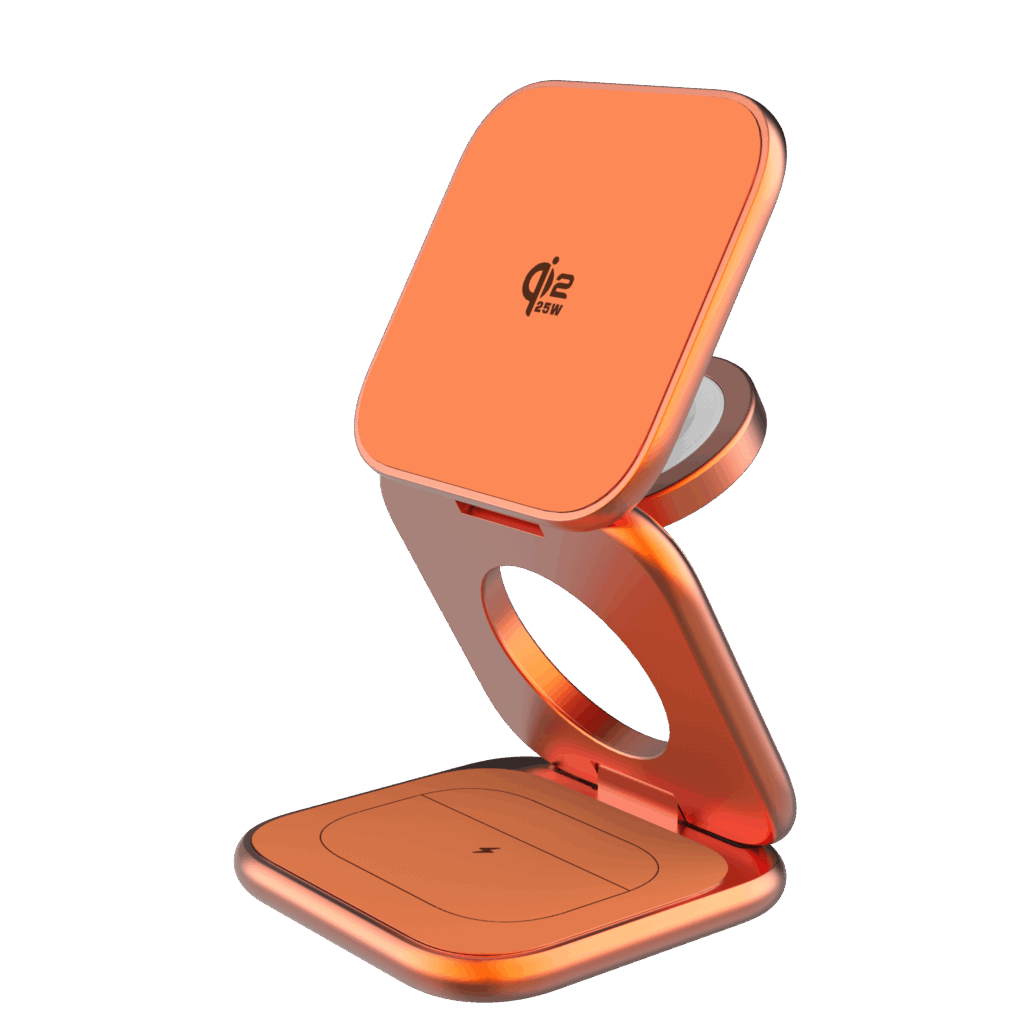
What can change on an existing stand platform
Artwork, colour, finish, cable and packaging change without touching the tool.
The angle, the coil position, the base weight and the position of the second surface do not, because they are moulded or embedded in the assembly. Asking which items on a change list stay inside the existing tool is the fastest way to establish whether a programme is a branding exercise or a new mechanical design, and the factory can usually answer before a quotation is issued.
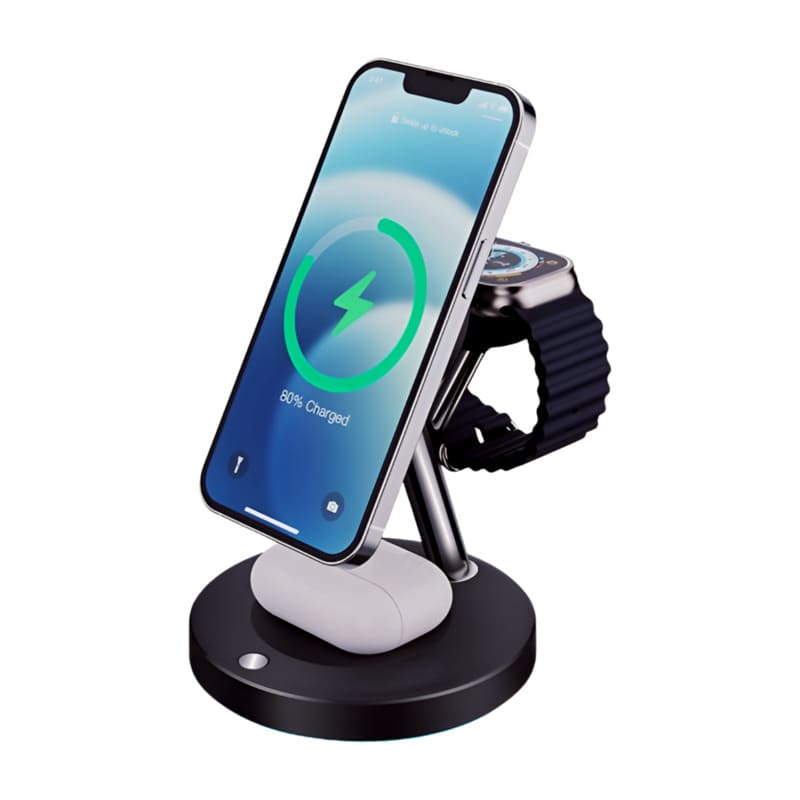
MOQ and lead time on a stand programme
A stand programme behaves like any other platform build until the body changes.
Where an existing body is used, the minimum follows the packaging print run and the test time, and the lead time is measured in weeks. Where the body or the base is new, the moulding batch becomes the binding constraint and the opening quantity rises with it. The base is often the surprise here: a weighted base can require its own tooling and its own structural test, which is why the format decision is really a tooling decision.
FAQ
What angle should a charging stand use?
It follows the use: a bedside stand usually needs enough angle for the screen to be readable, a desk stand often needs less. The angle sets how far forward the phone’s weight acts, which decides the base size and the stability margin. A bedside stand usually needs enough angle for the screen to be readable while a desk stand often needs less, and the angle sets the base size.
Does a stand need a multi-coil arrangement?
Usually not, because the lip and the resting surface position the phone and the coil can be placed once. A magnetic array is the exception, where the phone is held rather than rested or where the stand is used in a vehicle. Usually not, because the lip and the resting surface position the phone so the coil can be placed once, with a magnetic array as the exception.
How is stability tested?
By placing the heaviest supported phone at the most adverse angle and checking that the stand does not tip under a defined sideways force, then repeating after the joint, if any, has been cycled. The record belongs with the mechanical revision. Place the heaviest supported phone at the most adverse angle and check that the stand does not tip under a defined sideways force, then repeat after cycling.
Can a watch arm be added later?
Where the upper assembly was designed with the space and the thermal path, it can be a variant. Where it was not, adding the arm changes the upper tool and the thermal behaviour, and it becomes a new mechanical revision rather than an option. Where the upper assembly was designed with the space and the thermal path it can be a variant, and where it was not it becomes a new mechanical revision.
What is the smallest sensible first order for a stand?
On an existing body it is set by the packaging version and the test time, which keeps the opening quantity modest. A new body or a weighted base introduces moulding economics and moves the number up substantially. On an existing body the packaging version and the test time set the figure, while a new body or a weighted base introduces moulding economics.
Next step
Send the use case, the heaviest phone in the range, whether a second surface is required and the target markets to Wecent Group through the contact page. The reply proposes a format, states the coil and shield arrangement for it and gives the minimum quantity and the tooling position for each option. Related reading: wireless charger applications, OEM and ODM charger manufacturing and charger quality control. External references: Wireless Power Consortium, USB Power Delivery specification, IEC standards, EU CE marking rules, UL standards and certification and TUV testing services.
{“@context”:”https://schema.org”,”@type”:”FAQPage”,”mainEntity”:[{“@type”:”Question”,”name”:”What angle should a charging stand use?”,”acceptedAnswer”:{“@type”:”Answer”,”text”:”It follows the use: a bedside stand usually needs enough angle for the screen to be readable, a desk stand often needs less. The angle sets how far forward the phone’s weight acts, which decides the base size and the stability margin.”}},{“@type”:”Question”,”name”:”Does a stand need a multi-coil arrangement?”,”acceptedAnswer”:{“@type”:”Answer”,”text”:”Usually not, because the lip and the resting surface position the phone and the coil can be placed once. A magnetic array is the exception, where the phone is held rather than rested or where the stand is used in a vehicle.”}},{“@type”:”Question”,”name”:”How is stability tested?”,”acceptedAnswer”:{“@type”:”Answer”,”text”:”By placing the heaviest supported phone at the most adverse angle and checking that the stand does not tip under a defined sideways force, then repeating after the joint, if any, has been cycled. The record belongs with the mechanical revision.”}},{“@type”:”Question”,”name”:”Can a watch arm be added later?”,”acceptedAnswer”:{“@type”:”Answer”,”text”:”Where the upper assembly was designed with the space and the thermal path, it can be a variant. Where it was not, adding the arm changes the upper tool and the thermal behaviour, and it becomes a new mechanical revision rather than an option.”}},{“@type”:”Question”,”name”:”What is the smallest sensible first order for a stand?”,”acceptedAnswer”:{“@type”:”Answer”,”text”:”On an existing body it is set by the packaging version and the test time, which keeps the opening quantity modest. A new body or a weighted base introduces moulding economics and moves the number up substantially.”}}]}