
A branded wireless charger can open at 200 pieces per model – provided the coil, the magnet arrangement and the radio documentation already sit on a certified platform. Change the coil or the enclosure and the programme acquires tooling, sample loops and a radio assessment, with an opening quantity set by that investment rather than by the brand. The four decisions below are the ones that keep a wireless programme inside the first category rather than the second.
This guide is part of our Travel & Wireless Charging. Read the full topic guide for the decisions that come before and after this step.
OEM wireless charger programs: the four decisions that fix the programme
Four decisions fix the programme. Four decisions determine the tooling, the certification scope and the quality controls.
The platform and its radio certification, the coil and magnet specification, the enclosure and thermal design, and the production test that verifies charging behaviour. Each one can be answered with evidence before the order, and each determines what the programme costs and how long it takes.
The reason wireless products behave differently from wired ones is that the performance is a function of geometry and heat rather than of a single electrical rating. The distance between the coils, the alignment the enclosure provides and the path the heat takes out of the product decide the customer experience, and all three are fixed by the mechanical design before certification is booked.
Decision 1: the platform and its radio certification
Ask which platform the quotation is built on and which markets its reports cover.
A wireless charger is a radio transmitter, so the certification covers the assembly rather than the electronics alone. Where the platform holds reports for your markets and your configuration sits inside them, the branded programme is largely a documentation exercise. Where it does not, the radio assessment becomes part of the schedule. Ask for the report files, check the model number and the issuing laboratory, and confirm which markets are covered.
| Decision | Evidence to request | What it decides |
|---|---|---|
| Platform and certification | Reports naming the model and markets | Tooling, MOQ and test programme |
| Coil and magnet specification | Coil data, magnet grade, alignment target | Charging rate and consistency |
| Enclosure and thermal design | Temperature rise in the shipping enclosure | Sustained rate and derating |
| Production test | Test definition with a real device | What reaches the customer |
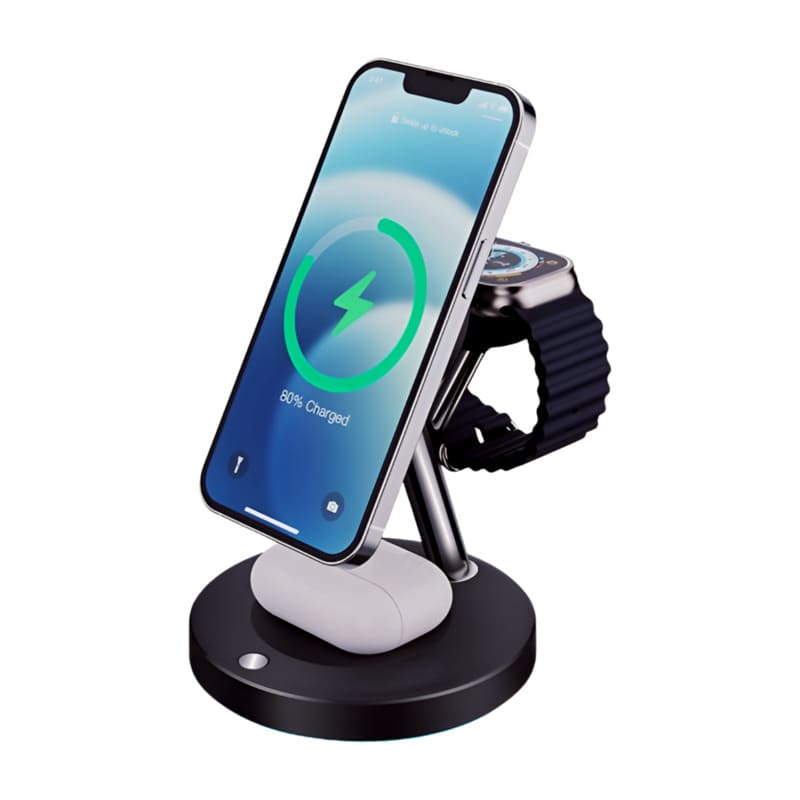
Decision 2: coil and magnet specification
Ask for the coil specification, the magnet grade and the alignment the design assumes.
Coupling depends on the total distance between the charger coil and the device coil, and that distance is assembled from the housing, the shield, the former and the adhesive before the customer’s case is added. The magnet array fixes the position, and its grade and geometry determine the holding force and the temperature above which the field weakens permanently. These are the numbers that decide whether the product performs on a customer’s phone rather than on a laboratory bench.
Decision 3: enclosure and thermal design
The relevant measurement is the temperature rise at the interface and at the surface over a sustained charge, in the shipping enclosure, at a stated ambient.
Wireless charging loses energy as heat at the coil interface, and a compact enclosure has less area to remove it. Where the design derates, the condition that triggers the reduction should be documented, because the customer experiences throttling as a charger that slows down rather than as a thermal control behaving correctly.
Decision 4: the production test
The functional test should verify charging behaviour with a real device at the intended position.
Testing with a fixed load proves the output works; it does not prove that the product charges at the alignment customers use. Ask whether the test uses a real device, how the position is fixed during the test, whether foreign object detection is verified, and whether the result is recorded per unit or per batch. On a magnetic product, the holding force after assembly is also worth checking on finished units rather than on the bare array.
Tooling, MOQ and the certified-platform trade-off
Where the platform exists, a branded run can open at 200 pieces per model with the enclosure, finish, label and packaging applied; samples are typically prepared in two to three days where the platform allows, and quotations are returned within 24 hours on business days.
A new enclosure or a new coil arrangement carries tooling, sample loops and a certification review, which sets a higher minimum and a longer calendar. Ask the quotation to state which of the two it represents and to separate the electronics, the coil and magnet assembly, the enclosure tooling and the packaging.
What the documentation pack should contain
Request the certification reports, the coil and magnet specification, the thermal measurement record, the functional test definition and the label artwork that names your model.
Wecent Group prepares certification groundwork for CE, FCC, RoHS, PSE and KC and confirms the current status per model. Where an item is missing, request it before the production order rather than after the first shipment, because the pack is what allows a customs query or a warranty claim to be answered without reopening the design discussion.

FAQ
What is the minimum order for a branded wireless charger?
From 200 pieces per model on an existing platform. A new enclosure or coil arrangement carries tooling and a higher economic minimum. The minimum on an existing platform is set by the packaging print rather than by the electronics, while a new enclosure or coil arrangement adds tooling and raises the economic minimum, which is set by the moulding economics of the die rather than by the order.
Does a new enclosure require new radio certification?
It depends on what changes. Cosmetic changes do not affect the assessment; a change in housing thickness, shield or magnet arrangement can require a review or a new submission. Cosmetic changes do not affect the assessment, while a change in housing thickness, the shield or the magnet arrangement can require a review or a new submission, because each touches a characterised parameter.
How is alignment verified in production?
By charging a real device at the intended position and, on magnetic products, checking the holding force on assembled units rather than on the bare magnet array. Charge a real device at the intended position and, on magnetic products, check the holding force on assembled units rather than on the bare magnet array, because the assembly sets the delivered position.
What thermal figures should a buyer request?
Interface and surface temperature rise over a sustained charge, in the shipping enclosure, at a stated ambient, with the intended device and case. Ask for the interface and surface temperature rise over a sustained charge, in the shipping enclosure, at a stated ambient and with the intended device and case, because those four conditions decide what the figure means in use.
Next step
Send the format, the device set and the target markets to Wecent Group through the contact page. The reply states the platform, the coil and magnet specification, the certification position, the MOQ and the sample timing. Related reading: wireless charger applications, OEM/ODM manufacturing and quality control. External references: Wireless Power Consortium, FCC equipment authorisation, EU CE marking, IEC standards, ISO 9001 and ECHA REACH.