
100W GaN Charger
100W is the band where a single charger stops being a phone accessory and starts replacing a laptop brick. Here is what it charges, why GaN matters more at this wattage than at 20W, and how a 100W programme is quoted.
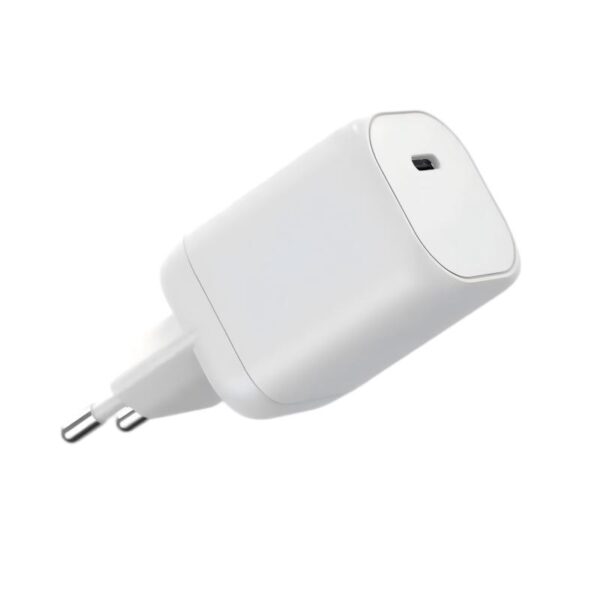
A 100W GaN charger covers a thin-and-light laptop with headroom, and can feed a phone on a second port at the same time. The band matters because it is the first one where a laptop negotiates at full speed over USB-C Power Delivery — and GaN is what keeps a 100W unit small enough to travel with.
What a 100W charger actually charges
The 100W band is where a charger stops being a phone accessory. Most thin-and-light laptops negotiate their full charging rate inside 100W over USB-C Power Delivery, which means one unit can replace the brick that ships in the laptop box — and often the phone charger as well, on the second port.
It is also the band where GaN stops being a marketing word and starts being the reason the product exists. A 100W silicon adapter needs enough volume to shed its heat; gallium nitride switches higher and loses less, so the transformer and the magnetics shrink and the housing can stay small enough for a laptop bag.
- Laptop coverage. The first band where a thin-and-light laptop charges at its own full rate over USB-C.
- Second port in practice. The laptop takes the large share, so the phone rate depends on the total budget — which is specified rather than assumed.
- Size, not just numbers. GaN is what makes a 100W unit pocketable instead of brick-sized.
65W, 100W or 140W?
The bands follow the devices. 65W covers most 13–14 inch laptops and the laptop-plus-phone case. 100W adds headroom for heavier 15-inch machines and for sustained load rather than a short burst. 140W and above is the multi-device desk band, where a docking station would otherwise sit on the desk.
| What you are choosing | 65W | 100W and above |
|---|---|---|
| Laptops covered | Thin-and-light, 13–14 inch | Thin-and-light with headroom, and heavier 15-inch units |
| Sustained load | Adequate; the smaller housing has less margin | More headroom for hours on a desk |
| Selling point | Pocket-sized travel SKU | One charger replaces the laptop brick |
| Typical channel | Travel retail, in-box accessory | Retail own-brand, laptop accessory, desk programmes |
The band selection logic is in the wattage guide, and the 65W reference point is the 65W travel charger page.
What you can change on a 100W charger
Everything below sits on a platform that already holds its reports, which is what keeps the sample at 2–3 days and the MOQ at 200 pcs per model.
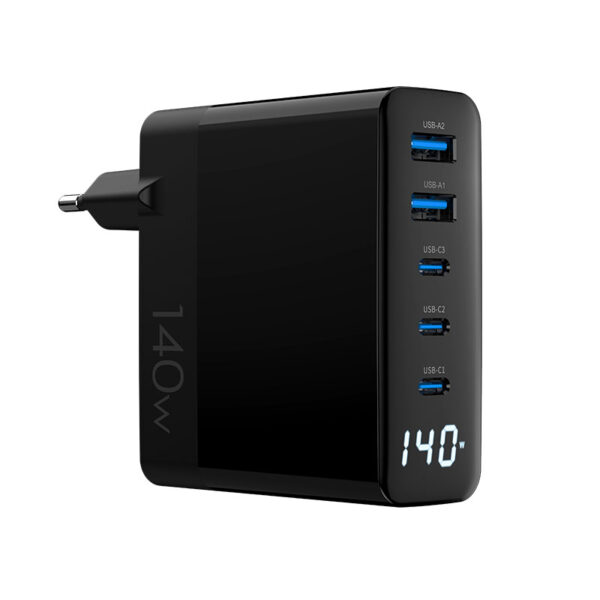
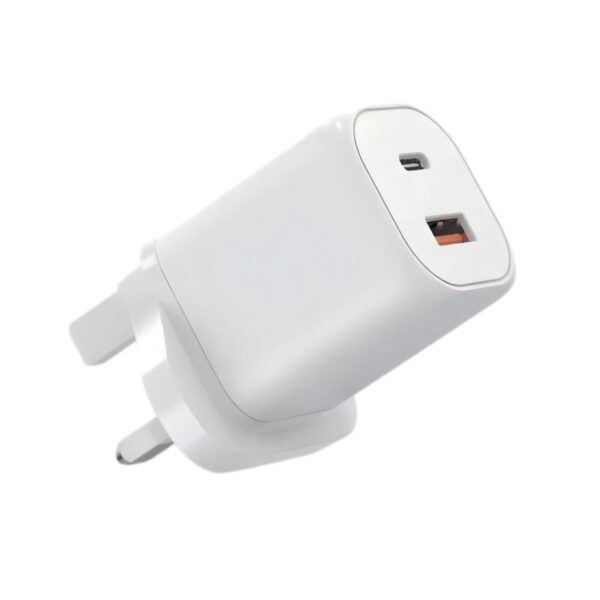
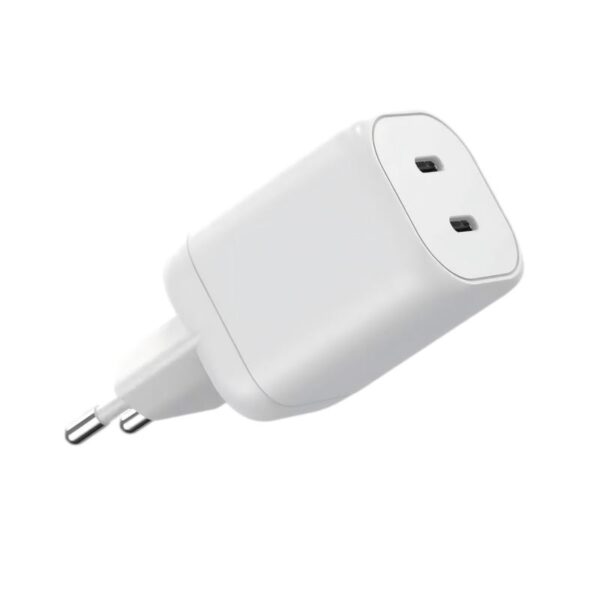
- Port layout — single port, 1A1C, 1A2C or 2C, with the shared budget stated on the datasheet.
- Plug — fixed or interchangeable EU / UK / US / AUS, chosen per market.
- Shell and finish — black and white as standard, plus custom shell colour and surface texture.
- Logo and packaging — silk-screen, laser or UV printing, plus a colour box drawn to your artwork.
100W GaN charger — specifications
| Output | 100W over USB-C Power Delivery; 140W and 240W platforms available on neighbouring bands |
|---|---|
| Port layouts | Single port, 1A1C, 1A2C and 2C depending on the model |
| Protocols | PD 2.0/3.0 and QC 2.0/3.0; PPS ranges, AFC, FCP, Apple 2.4A and BC1.2 tested per family |
| Shared budget | The per-port behaviour under load is stated on the datasheet rather than inferred from the total |
| Plug types | Fixed or interchangeable EU / UK / US / AUS, plus KR where the channel needs it |
| Mains input | Universal AC input; the marked range is confirmed on the model datasheet |
| Certifications | CE, RoHS, FCC, UKCA, PSE, KC, SAA and CB reports for a 100W GaN charger, depending on the target market |
| MOQ | 200 pcs per model for a branded 100W GaN charger; a trial quantity can be split across a few SKUs |
| Samples | 2–3 days with your logo and finish applied to the 100W GaN charger |
| Mass production | 7–15 days after sample and artwork approval for the 100W GaN charger |
| Carton | 50 pcs per carton as standard for the 100W GaN charger, or customised to your requirement |
| Warranty | 2 years on the 100W GaN charger, with a 24-hour complaint response and batch traceability |
The rows above describe a standard 100W GaN charger. Custom power stages, coil layouts, plugs and packaging are quoted per project, and every figure is confirmed on the datasheet before a sample is built.
100W platforms in production
How a 100W GaN charger is built and checked
At 100W the thermal margin is thinner than at 20W, so the aging cycle carries more weight here: a platform that looks fine on a bench does not always hold up in a sealed housing.
Material preparation and checking
The GaN switches, transformer, capacitors, controller, plug assembly and shell are checked against the approved bill of materials before a 100W board reaches the line.
First-piece quality confirmation
The first unit of a run is built and load-tested at full output against the specification before the line continues, which is where a platform that derates under sustained load gives itself away.
Assembly on static-protected lines
Boards are assembled on static-protected lines to a written operation sheet, with the plug assembly — fixed or interchangeable — fitted and checked at its own station.
Visual inspection rounds
Repeat inspections verify solder joints, component placement, screw torque, plug fit and the cosmetic condition of the shell and its markings.
Aging under load and electrical testing
Every unit runs an aging cycle at load and is re-measured afterwards; at 100W the thermal margin is thinner than at 20W, so this gate carries more weight here.
Charging and protocol verification
Output voltage and current are measured across every port at once and individually, including PPS ranges, with handshake checks for PD, QC, AFC, FCP, Apple 2.4A and BC1.2.
QA sampling, packing and shipment inspection
Sampling runs before packing, the plug kit, marking and retail box are checked against the approved artwork, and the batch report keeps the shipment traceable per market.
The route is identical whether the unit leaves as a 100W wall charger or a plug-kit SKU — the plug assembly is the only part that changes.
Where a 100W charger gets specified
Laptop accessory retail
One charger that replaces the brick in the box, sold as an own-brand SKU.
Travel retail
A plug kit and a pocket-sized housing — the case a 100W GaN unit was designed for.
In-box accessory
Supplied with a laptop or dock, with the rating matched to what the device negotiates.
Office and desk programmes
One adapter per desk for a laptop plus a phone, with a stated shared budget.
Certifications and what comes with the shipment
The file for a 100W GaN charger is assembled from the first sample rather than hunted down before dispatch, so the paperwork matches the market the container is going to.
CE / UKCA
European Union and United Kingdom market access for the finished unit and its power supply.
FCC
United States electromagnetic compliance for the finished unit.
RoHS / REACH
Restricted-substance documentation for the European market.
PSE / KC
Japan and Korea market documentation, quoted with the plug kit.
CB / SAA / GS / ETL
Additional reports quoted where the channel or retailer requires them.
ErP efficiency
Efficiency documentation for the EU external power supply regulation.
Reference standards behind this page: Wireless Power Consortium (Qi / Qi2), EU external power supply regulation (ErP), EU CE marking and the USB Implementers Forum for USB-C and Power Delivery specifications.
Related guides and platforms
GaN chargers explained
What gallium nitride changes, and where it does not help.
GaN vs silicon
The technical comparison behind the size difference.
Multi-port chargers
How the shared power budget works across several ports.
Choosing a wattage band
How 20W, 45W, 65W and 100W map onto devices.
Charger adapters 20W to 240W
The full band range with fixed or plug-kit options.
Certification for the EU and US
What the compliance file needs, and when to start it.
100W GaN charger — FAQs
What does 100W GaN charger mean?
It means the charger delivers up to 100W over USB-C Power Delivery, and that it uses gallium nitride switches rather than silicon. The GaN part is about size and heat: it lets the transformer and magnetic parts shrink, so a 100W unit stays small enough to travel with instead of being a brick.
Are GaN chargers actually better?
They are smaller for the same wattage and run cooler, because higher switching frequency shrinks the magnetics and reduces the switching losses. Whether that is worth the premium depends on the product: for a travel or in-box SKU the size advantage is the whole point, and for a stationary unit it buys less.
What are the downsides of using a GaN charger?
The honest one is cost — the switch and its control circuitry are more expensive than an equivalent silicon design. The other is that a smaller housing has less thermal headroom, so the design has to be validated under sustained load rather than at a peak reading.
Which 100W GaN charger is the best?
There is no single answer, because “best” depends on the port layout and the plug strategy your channel needs. The useful comparison is whether the per-port budget is published, whether the plug kit matches your markets, and whether the platform already holds reports for them.
Will a 100W charger damage a phone?
No. The device negotiates the rate it supports and the charger delivers only that. A higher-rated unit simply has more headroom available, which is why one 100W charger can feed a laptop and then a phone without either being over-supplied.
Can one 100W charger charge a laptop and a phone at once?
Yes, but the ports share one power budget: when the laptop takes its share the phone charges at a lower rate. That behaviour is specified per model and stated on the datasheet, rather than left for the customer to discover.
What is the minimum order?
200 pcs per model, and a trial quantity can be split between two wattages on the same platform family — often 65W and 100W — so the first order tests two bands rather than one.
How fast are samples and production?
Samples ship in 2–3 days with your logo and finish applied; mass production runs 7–15 days after sample and artwork approval, and a container programme takes 3–5 weeks.
Which certifications apply?
CE, RoHS, FCC, UKCA, PSE, KC, SAA and CB reports depending on the target market, with ErP efficiency documentation for the external power supply — which is what a retailer asks for before listing.
Can the plug be changed for different markets?
Yes. The same board ships behind a fixed plug for a domestic programme or an interchangeable EU/UK/US/AUS kit that collapses four markets into one SKU, which usually matters more to a distributor than the unit price difference.
100W chargers in more detail — what the band is for and how to source it Know more Know less
Why 100W is the laptop band
Most thin-and-light laptops negotiate their charging rate over USB-C Power Delivery, and the rate sits inside 100W. Below that band the laptop charges more slowly than it would from its own brick; above it, the extra headroom is only used by heavier machines or by multi-port layouts feeding several devices.
That makes 100W the practical replacement point: one unit that covers the laptop, with a second port for a phone. It is also why the band is popular with distributors — it sells to anyone who owns a laptop, not only to phone buyers.
Sustained load and thermal headroom
A 100W charger is judged over hours, not minutes. The same energy is dissipated in a smaller housing, so the design question is how much thermal margin the platform has when the unit is left under load on a desk rather than used in a short burst.
That is why units are aged at load during production and re-measured afterwards. A platform that reaches 100W briefly but cannot hold it in a sealed shell is caught at that gate rather than in a customer’s return.
How the power is shared across ports
On a multi-port 100W unit the ports share one budget. A laptop on USB-C takes most of it, and the second port charges whatever is left — which is usually fine for a phone and is exactly what the customer expects, but only if it is stated rather than assumed.
The per-port behaviour belongs on the datasheet next to the total rating, because two units with the same 100W label can allocate it very differently.
Sourcing a 100W programme
Send the laptop and phone list, the markets and whether the SKU travels. You get the platform, the per-port allocation, unit pricing at your quantity and the certification list for each destination.
Orders start at 200 pcs per model, and a trial quantity is usually split between 65W and 100W on the same platform family — which is how most laptop-facing ranges begin.
Send your spec, get a costed quotation
Tell us the laptops and phones the charger has to cover, the markets, and whether the SKU travels. You get the platform, unit pricing at your quantity, the sample date and the certification list per destination.
- MOQ from 200 pcs per model, splittable across a few SKUs
- Samples in 2–3 days with your logo and finish applied
- Reply within 24 hours on business days