
A single final inspection can only reject defects that are visible or measurable at the end of the line. By then the cause – a wrong component, a cold solder joint, a mis-set fixture – has already been repeated across the batch. Gates exist to catch each failure close to where it happens.
Last updated:
This guide is part of our Charger Quality & Inspection. Read the full topic guide for the decisions that come before and after this step.
Why five gates beat one final inspection
Each gate answers a different question. Incoming inspection asks whether the materials are what the BOM specifies. In-process inspection asks whether the assembly process is under control. Electrical test asks whether the unit functions. Aging asks whether it continues to function under load. Outgoing inspection asks whether the finished, packed unit matches the approved sample. Removing a gate does not save the inspection time; it moves the cost to the customer’s return process.
IQC: incoming materials and BOM verification
Incoming inspection compares received components with the approved BOM and the supplier’s documentation: part number, marking, packaging, quantity and, where required, a sample measurement. The failure it prevents is the substituted or mis-labelled component, which is difficult to detect after assembly and impossible to detect visually once the enclosure is closed.
IPQC: soldering, assembly and in-process checks
In-process inspection covers static control at the soldering stations, solder joint quality, mechanical assembly, cable routing and connector seating. It is performed on the line at defined intervals rather than only at the end, which is what allows a drift to be corrected before it affects the whole batch. The records are process records: settings, intervals, findings and corrections.
Electrical test and aging under load
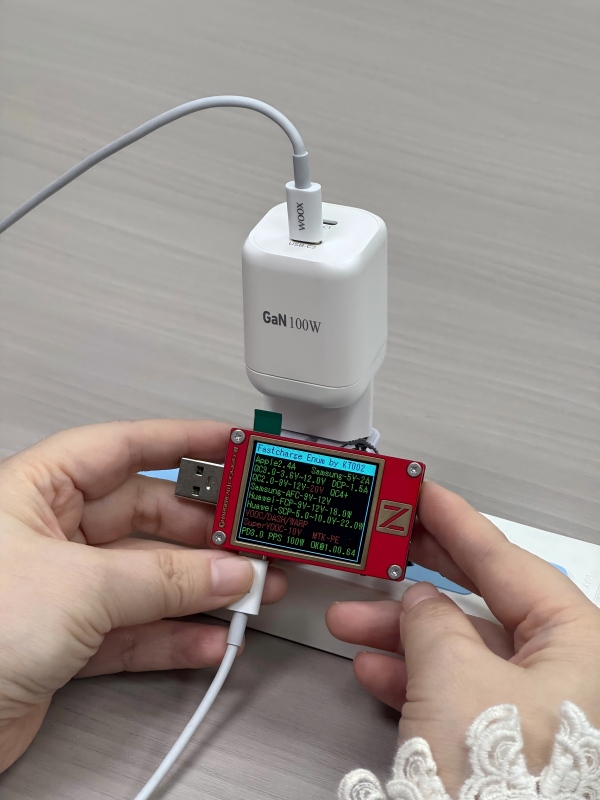
Every unit should pass a functional test that confirms output voltage and current behaviour, port detection and protection functions. Aging under load then runs the unit for a defined period at a defined load, which is where intermittent faults, thermal problems and marginal components reveal themselves. The combination is the strongest single defence against field failure, and it should be applied to 100% of units rather than to a sample.
OQC: outgoing inspection and sampling
| Gate | Scope | Typical record |
|---|---|---|
| IQC | Components and materials | Incoming inspection report |
| IPQC | Soldering, assembly, in-process checks | Process and interval records |
| Electrical test | 100% of units | Test result by unit or batch |
| Aging | 100% of units, defined load and duration | Aging log |
| OQC | Appearance, packing, accessories, sampling | Outgoing inspection report |
Outgoing inspection applies the sampling plan agreed with the customer and covers appearance, labelling, accessories and packing. It is the last gate before shipment and the one that produces the report the buyer reads.
What each gate records and retains
Records should identify the batch, the inspector, the result and the disposition. A record that states only “passed” cannot support an investigation; a record that states the parameter, the measured value and the limit can. Retention follows the quality agreement and should at least cover the warranty period.
Which measurement catches which defect
- Wrong or counterfeit component – incoming inspection
- Cold or bridged solder joint – in-process and electrical test
- Mis-seated connector – in-process and functional test
- Intermittent output – aging under load
- Missing accessory or wrong label – outgoing inspection
How a gate failure is escalated
A gate failure should trigger a defined response: hold the affected units, identify the scope, correct the process, verify the correction and record the outcome. Where the failure indicates a systemic cause rather than an isolated unit, the corrective-action process applies. The escalation path matters as much as the gate itself, because a gate that produces a finding nobody acts on is only a form.
Buyer questions per gate
- What is inspected at IQC, and against which document?
- What is checked in-process, and at what interval?
- Are electrical test and aging applied to every unit?
- What sampling plan applies at outgoing inspection?
- Which records are retained, and for how long?
Gate frequency, sample size and interval
Each gate has its own rhythm. Incoming inspection is performed per receipt, because the risk is a specific delivery from a specific supplier. In-process checks run at defined intervals during the shift, so that a drift is detected before a large quantity is built. Electrical test and aging are continuous, because they apply to every unit. Outgoing inspection is performed once per lot, against the agreed sampling plan. Setting these frequencies is a decision about risk and cost: more frequent in-process checks catch problems earlier but consume production time, while a longer interval saves time and widens the exposure if something changes. The frequencies should be written into the control plan and reviewed when a process, a component or a line changes, because an interval that was appropriate for a stable process may not be appropriate after a change.
Evidence gate: separate 100% tests from sampled inspection
A batch report is useful only when it states what was tested on every unit, what was sampled and which acceptance rule controlled the decision. The three records must point to the same model and production lot.
Use the following record with the article’s technical guidance and confirm the applicable requirements against the linked authoritative source.
| Buyer verification step | Evidence to request | Pass condition | Stop condition |
|---|---|---|---|
| Test method | Approved procedure and equipment list | Method, limits and instrument are identified | The report says only pass or fail |
| Coverage | Unit-level log or sampling plan | 100% and sampled checks are clearly separated | A sample result is presented as a unit-level test |
| Traceability | Lot, date, line and model identifiers | The report traces to the shipment | The tested lot cannot be linked to the order |
| Failure action | Nonconformance and corrective-action record | Failures have disposition and retest evidence | Failed units disappear from the summary |
Conditions that stop the release
- Do not accept a report that omits the test limit, sample size or lot identity.
- Stop release when failed units lack a documented disposition, corrective action and retest result.
FAQ
How many inspection gates should a charger factory have?
Five is a practical structure: incoming, in-process, electrical test, aging and outgoing. The number matters less than the fact that each gate has a defined scope, a record and an escalation path.
What is aging under load and why does it matter?
It runs the charger at a defined load for a defined period to reveal thermal and intermittent faults that a short functional test misses. Applied to every unit, it is the most effective screen for marginal assemblies.
Is OQC the same as AQL sampling?
OQC is the gate; AQL is one sampling method used at it. The gate may combine 100% checks on some characteristics with sampling on others.
Next step
Wecent Group applies documented inspection gates with electrical test and aging on every unit, and retains batch records for traceability. Send your quality requirements to the contact page. Related reading: quality control, AQL batch reports, factory floor and batch traceability. External references: ISO 9001, ISO 2859-1 sampling, AIAG, IEC standards, UL and Intertek.
More on this topic: wireless charger manufacturing and wireless charging pads.