
You are finalising a charger range and two quotations land on your desk: the same 65W output, two different bills of materials, one roughly a size smaller than the other. The gap is the power semiconductor. This article is about which wattage tiers justify GaN, what stays identical for your brand either way, and the questions that separate a real GaN design from a marketing label.
The short answer for a product-line decision
GaN transistors switch faster and lose less energy as heat, so a GaN charger reaches the same wattage with smaller magnetics, tighter spacing and less thermal headroom reserved for cooling. Silicon remains the lower-cost, lower-risk choice at 20W-45W; GaN earns its premium from roughly 65W upward, where size and multi-port heat density decide whether the product is competitive on a shelf.
| Wattage tier | Silicon | GaN | Commercial reading |
|---|---|---|---|
| 20W-45W single port | Mature, lowest BOM cost, adequate size | Marginal size and heat benefit | Silicon is usually the right commercial choice |
| 65W-100W multi-port | Feasible but bulkier and warmer under sustained load | Compact enclosure with 1A1C to 2A3C layouts | GaN carries the size and thermal argument |
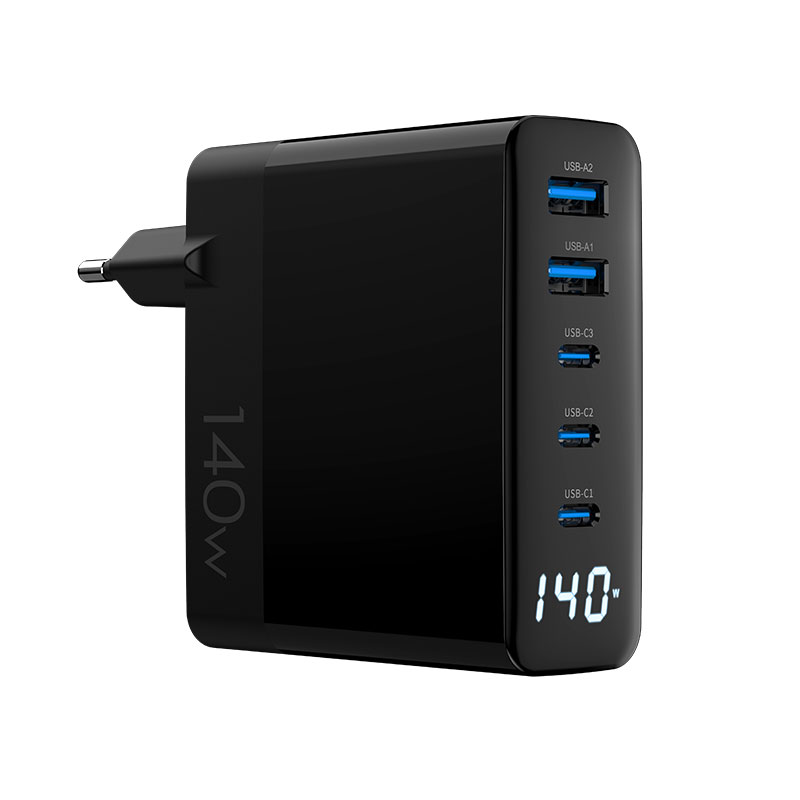
| 140W-240W desktop | Large enclosure, significant thermal design effort | Practical multi-device desktop format | GaN is effectively required for the category |
What GaN changes inside the charger
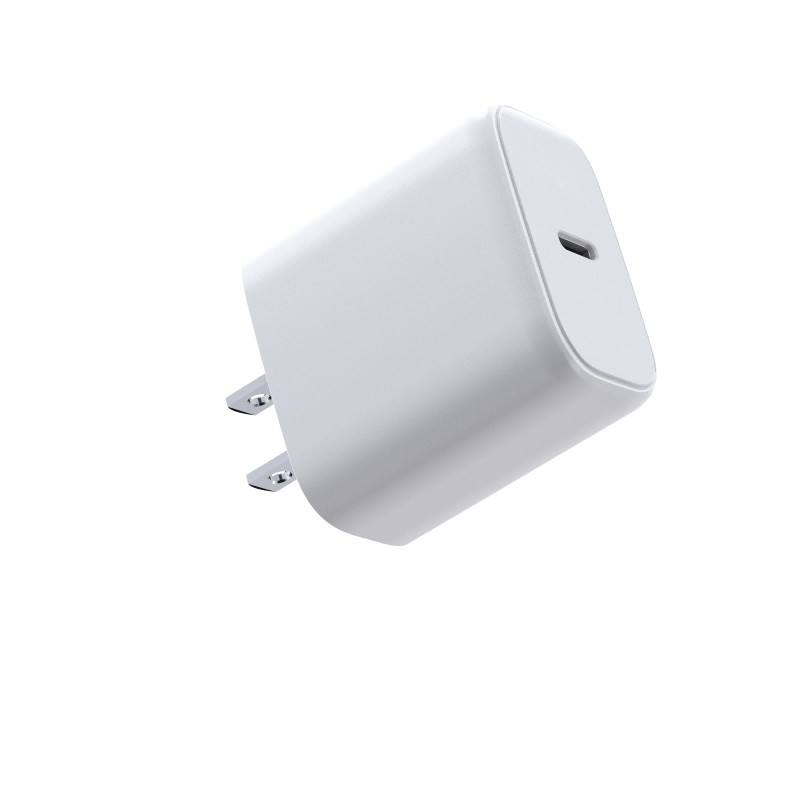
Gallium nitride is a wide-bandgap semiconductor: it tolerates higher switching frequencies and higher operating temperatures than silicon MOSFETs of comparable rating. The practical consequence is not a marketing property but a mechanical one – the transformer, inductors and output capacitors that dominate a charger’s footprint can shrink. Two engineering effects follow. First, the power stage can be laid out in less space, which is why a 65W GaN adapter fits a form factor that a few years ago held 30W. Second, because less energy is converted to heat, the thermal design can either run cooler or accept a more enclosed housing.
The topology matters as much as the material. A quoted “GaN charger” may be built around a quasi-resonant flyback, an active-clamp flyback or an LLC stage depending on wattage, and each has different efficiency behaviour across the load range. Ask which topology is used, because it tells you more about real-world performance than the word GaN on the specification sheet.
What does not change for the buyer
Switching material does not change the interface your customer experiences. USB Power Delivery negotiation, PPS voltage stepping, cable requirements, port count and plug systems are defined by the protocol and the mechanical design, not by the transistor. Safety and EMC compliance are likewise unchanged: the applicable safety standard for this product family, the EMC framework and the regional marking requirements stay the same whether the charger uses silicon or GaN.
For a brand owner, that means a GaN platform does not remove certification work; it changes the thermal and electromagnetic behaviour that the test house evaluates. The worst-case build for testing and the pre-scan process still apply.
Size and thermal headroom by wattage tier
At 20W-45W, a silicon design already meets the size expectations of the category, and the GaN premium buys little that the customer can perceive. At 65W-100W the picture changes: multi-port chargers run several rails simultaneously, so heat density – not peak wattage – is the limiting factor. Here GaN allows a smaller enclosure without forcing a fan or an oversized thermal pad. Above 140W the choice is largely made for you: multi-device desktop charging at that level is impractical in silicon without a substantial enclosure.
Efficiency claims: how to read them without being misled
An efficiency figure is only meaningful with three conditions attached: the load point, the line voltage and whether the value refers to the power stage alone or the complete adapter. A charger quoted at a high efficiency at 50% load and a stated input voltage can still run noticeably warmer at full load in a 40°C room. When comparing quotations, ask for the efficiency curve across 25%, 50%, 75% and 100% load rather than a single number, and ask whether the measurement was taken at nominal and at the lowest rated line voltage. A supplier who can supply the curve is describing a tested design; a supplier who can only supply a headline figure is describing a brochure.
Cost position: where GaN pays for itself
GaN devices cost more than equivalent silicon at the component level, and the difference is most visible at low wattage. The BOM penalty is partly offset by smaller magnetics, fewer thermal components and sometimes a smaller enclosure, but at 20W-45W the net effect is usually a higher unit cost without a customer-visible benefit. At 65W and above, the comparison moves: the alternative to GaN is not a cheaper charger but a materially larger one, and in multi-port designs the thermal solution that silicon requires can erase much of the component saving. The honest way to evaluate it is to compare the landed cost of the finished product at the size and heat performance your channel actually requires, not the cost of the transistor alone.
Where silicon still wins
Silicon stays competitive in three situations. The first is low-wattage, single-purpose products – a 20W phone charger, a bundle accessory, a promotional item – where cost sensitivity dominates and the enclosure has room to breathe. The second is very price-driven private-label programmes where the specification is fixed and the customer compares on cost per unit. The third is engineering risk: a mature silicon platform has a longer production history, a wider supplier base and, for a brand launching its first charger, fewer variables to control.
None of this makes GaN a gimmick. It means the material should be selected per SKU against a size, thermal and price target rather than applied across a range for consistency of marketing message.
Certification and compliance implications
GaN does not change which standards apply, but it does change the electromagnetic and thermal profile the test house sees. Higher switching frequencies shift conducted and radiated emissions, which is why pre-scan work matters more on a new GaN platform than on a derivative of an existing one. The energy-efficiency requirements that apply in some markets are assessed on the finished product, so the benefit of a more efficient design shows up in the compliance file as well as in the thermal measurement.
For a multi-region programme, the sensible sequence is to certify a platform once at the worst-case configuration and then derive branded and plug-kit variants from it, rather than certifying each SKU independently. That approach keeps the certification clock from restarting every time a variant is added.
Which SKUs in your range should be GaN?
A practical allocation for a first range is to reserve GaN for the SKUs where the customer can see the difference – the travel adapter, the multi-port laptop charger and the desktop charger – and to keep the entry-level accessories on silicon. The table below is a starting allocation by SKU type rather than a rule.
| SKU type | Recommended technology | Reason |
|---|---|---|
| 20W-30W single-port accessory or bundle item | Silicon | Cost-led; size expectation already met |
| 45W travel adapter | Either, subject to size target | Decided by the plug mechanism and enclosure volume |
| 65W-100W multi-port charger | GaN | Heat density and port count |
| 140W-240W desktop charger | GaN | Category is not practical in silicon at this size |
| Qi2 / MagSafe wireless stand | Independent of this decision | Wireless charging has its own coil and thermal design |
Questions to ask a charger factory before you commit
- Which topology and which GaN device family are used at each wattage tier, and is the controller from the same generation as the switch?
- Can you provide efficiency curves at 25%, 50%, 75% and 100% load, at nominal and low line voltage?
- What temperature rise is measured at full load in the intended enclosure, and at what ambient?
- Which platform is the design derived from, and what is already certified on it?
- What is the worst-case build you would submit for certification, and why?
- How does the BOM and enclosure size change between the silicon and GaN versions of the same wattage?
Frequently asked questions
Is GaN worth it for a 20W charger?
Usually not. At that wattage a silicon design already meets the size and thermal expectations of the category, and the GaN premium is difficult to justify commercially unless the product shares a platform with higher-wattage SKUs and the commonality itself saves money.
Do GaN chargers need different certification?
The standards and markings are the same; what changes is the electromagnetic and thermal behaviour evaluated during testing. A new GaN platform should be pre-scanned rather than assumed to inherit the results of an older silicon design.
Why are GaN chargers smaller?
Higher switching frequency allows smaller transformers, inductors and capacitors, and lower losses reduce the space that must be reserved for heat dissipation. The size advantage grows with wattage, which is why it is most visible in multi-port and desktop chargers.
Can one platform cover both silicon and GaN versions?
Sometimes, but the magnetics and thermal design differ enough that a shared enclosure usually compromises one of the versions. It is more practical to plan two related platforms than to force one.
Next step
If you are deciding the technology mix for a charger range, send Wecent Group the device list, the wattage tiers you are considering and the markets you plan to sell into. The response is a costed view of which SKUs suit silicon, which justify GaN, and what the certification path looks like for each – with the platform options, minimum quantities and sample timing stated up front.
Useful references: USB Implementers Forum documentation, IEC standards, FCC equipment authorisation, EU RoHS directive, EU energy-efficient products. See also our GaN charger platforms, 65W-100W range and quotation request page.