
Travel & Wireless Charging
Wireless charging sells on the desk and the bedside table; travel adapters sell on the plug. This guide covers the platforms behind both, and what actually decides whether a wireless charger performs.
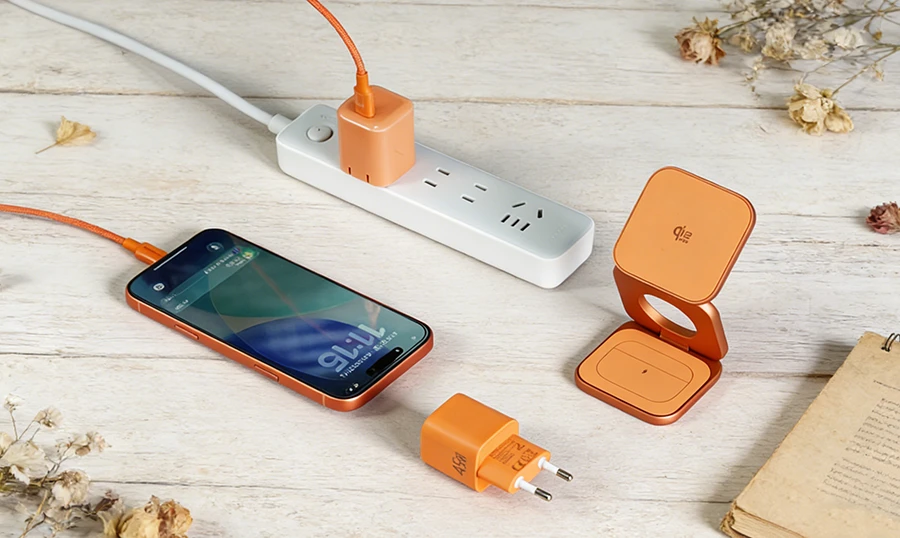
Three routes, and you only need one of them
Choosing a wireless platform, sourcing a manufacturer, and building a travel adapter range are three different jobs. Start with the one you are actually doing.
Choose the wireless platform
Pad, stand, desk or 3-in-1. The format decides the coil layout, the magnet array and the thermal design.
Source the manufacturer
Wireless quality lives in alignment and thermal behaviour, and both are visible in the specification.
Build the travel range
Travel is a plug problem before it is a power problem, and the plug kit decides how many SKUs you carry.
The three things that decide whether wireless charging works
Wireless is judged on the desk, not on the datasheet. Alignment, heat and the case on the phone decide the experience.
Coil alignment is the whole product
A wireless charger that requires the phone to be placed exactly is a charger that will be returned. The magnet array exists to make alignment automatic.
Heat, not distance
Wireless losses appear as heat in the phone and the pad. How the pad dissipates that heat decides whether the charge rate holds after ten minutes.
The case on the phone
Case thickness and any metal in the case change the coupling. A pad specified without a case allowance will underperform in the field.
Travel adapters are a plug strategy, not a product
The charging electronics are usually the easy part. What decides your SKU count is how many plug types you support and whether you ship them as one kit or as separate lines.
One platform, several plug heads
A single platform with interchangeable heads keeps certification and tooling to one product while covering several markets, at the cost of a larger box.
Wattage for the trip, not the desk
A travel charger is usually the only one a customer carries, so the port mix matters more than the total output. Two ports that share well beat one port that is fast.
The travel case is part of the product
In travel, the packaging and the case are what the review photos show. Treating them as an afterthought is the most common travel-range mistake.
What actually decides whether a wireless charger sells
Whether the phone lands in the right place
Magnetic alignment turned wireless charging from a novelty into a habit. Positioning is a product feature, not a convenience.
What happens after ten minutes
The advertised rate and the sustained rate are different numbers. Sustained behaviour is what customers experience and what reviews report.
How many devices sit on it at once
A 3-in-1 is judged with all three loaded, and the allocation between them is where cheap designs become obvious.
What the box contains
A wireless charger without a matching adapter is a support ticket. The power supply is part of the specification, not an accessory.
Where to go from here
Four guides that pick up where this one stops.
GaN charger technology
Wattage tiers and protocol sets.
Open the guide →Export & market entry
Plug kits, certification and labels.
Open the guide →OEM & ODM programmes
Turning a platform into your product.
Open the guide →Packaging & sustainability
Retail packaging and paper options.
Open the guide →Travel and wireless charging questions
What is the difference between Qi, Qi2 and MagSafe-style magnetic charging?
Qi is the original inductive standard. Qi2 adds a magnetic alignment profile, so the phone snaps into the correct position. Magnetic charging uses the same magnet array idea, and the benefit in both cases is alignment rather than raw speed.
Why does my wireless charger get hot and slow down?
Wireless transfer is less efficient than a cable, and the losses appear as heat in both the phone and the pad. When the temperature rises, the phone reduces its charge rate. Better thermal design and correct alignment are what keep the rate steady.
Should a travel charger have one port or several?
Several, because a travel charger is usually the only charger the customer carries. Two ports that share intelligently cover a phone and a laptop, which is the actual travel scenario.
Can one travel charger cover every country?
The electronics usually can. What changes is the plug head, and whether you ship a kit with interchangeable heads or separate SKUs per region. The kit covers more markets with one product; separate SKUs are cheaper per unit.
Do wireless chargers need their own power adapter?
Yes, and it should be in the box. A pad that reaches its rated output only with a specific adapter is a support problem waiting to happen if the adapter is not included.
Send us the device mix and the markets
Tell us which devices the product has to charge, how many ports you want and which countries you sell into. We will come back with the platform and the plug kit.