
The surface that causes the most trouble on a 3-in-1 charger is usually the watch coil, and the reason is mechanical rather than electrical. The watch has to sit against a small coil at a fixed angle, the phone has to land on the largest coil while the stand carries its weight, and the earbud case is expected to charge wherever it is dropped. Five decisions set how well those three surfaces coexist, and they are taken before the tool is cut.
This guide is part of our Travel & Wireless Charging. Read the full topic guide for the decisions that come before and after this step.
3-in-1 wireless charger platforms: five decisions that shape the product
Five decisions fix the product. Five decisions fix the configuration: the device set, the stand form, the power budget, the travel question, and the certification scope.
Each decision changes the mechanics, the thermal path or the input, and each is cheaper to take before the enclosure exists. A platform already in production carries most of them as fixed features, so the real work is identifying which platform matches the brief.
Brands often specify the three devices first and stop there. The device list is necessary and not sufficient: the same three devices can be served by a fixed desktop stand, a foldable travel design or a flat pad with a watch arm, and the three differ in tooling, size, thermal behaviour and price.
Decision 1: which three devices the product serves
The device list sets the coil count, the coil sizes and the angles.
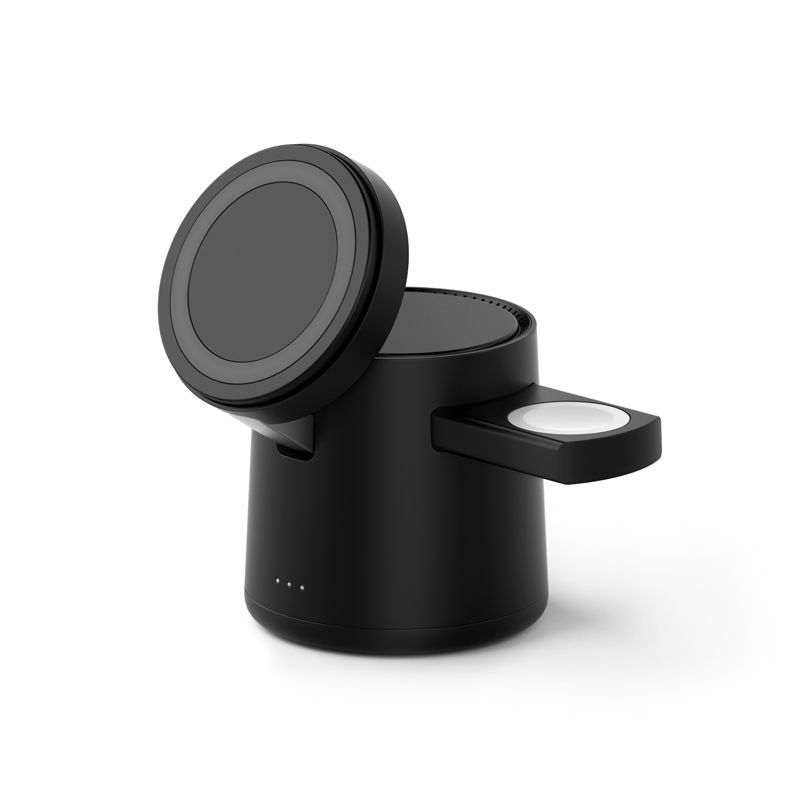
A phone, a watch and an earbud case is the common combination, and each element has a different coil geometry and a different tolerance to misalignment. The watch surface in particular needs the coil axis to meet the watch face squarely, which fixes an angle in the mechanics. Write the device list with the models and the case assumptions, because the coil positions of the receiving devices vary by generation.
Decision 2: the stand form and the phone surface
The stand carries the phone, so its geometry is a mechanical decision before it is a design one.
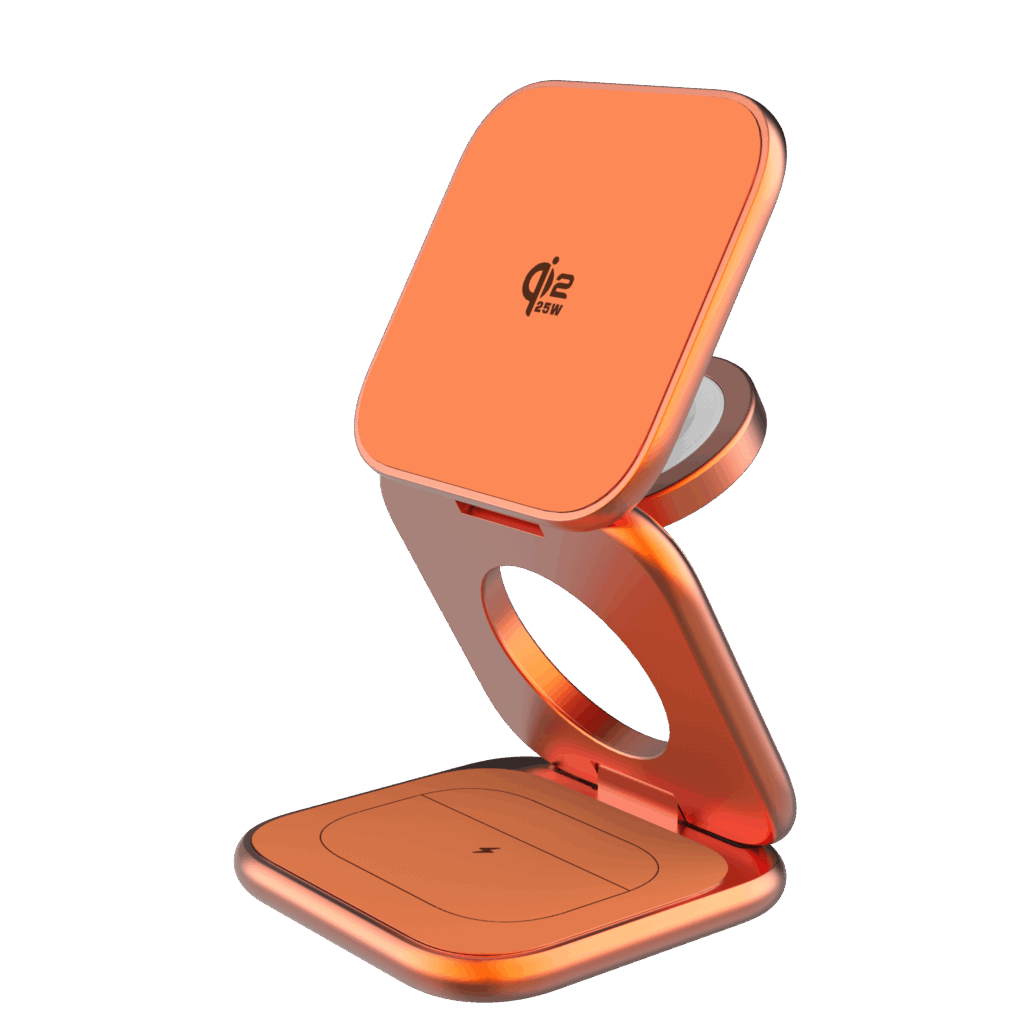
A raised stand holds the phone at an angle for viewing, which puts a moment on the joint and requires the base to be heavy enough not to tip. A flat pad with a watch arm avoids the joint and the moment. A foldable travel design adds a hinge and a second mechanical failure point in exchange for size. Whichever is chosen, the phone surface has to keep the phone in contact while supporting its weight, and that constraint is usually what decides the base dimensions.
Decision 3: the power budget and the input
Three surfaces sharing one input means the budget has to be allocated, not assumed.
The input adapter determines the total available power, and the design decides how it is shared when all three surfaces are occupied. A specification that states the delivered power per surface simultaneously is different from one that states the maximum on one surface at a time, and the customer will experience the difference on a bedside table. State the sharing rule, the required adapter and the behaviour when the input is smaller than the design can use.
Decision 4: foldable travel or fixed desktop
Portability changes the internal structure more than it changes the electronics.
A foldable design needs the coils to remain aligned after the hinge has been cycled, which is a tolerance question rather than a component question, and it needs a cable and plug arrangement that survives being packed. A fixed desktop stand avoids both and can carry a larger thermal mass, which usually means a higher sustained rate on the phone surface. The retail channel decides this one: a travel product and a bedside product are bought by different customers.
Decision 5: certification scope and the market list
The market list has to be written before the platform is chosen.
Certification covers the radio interface, the safety of the adapter and the electromagnetic behaviour of a product with three coils in one housing and a single input. A platform that already holds the relevant reports removes the longest step from the programme; a platform that holds them for two of the four destinations adds a submission for the remainder. The plug and cable accessory set follows the same list.
| Decision | Options | What it fixes | Where it costs money |
|---|---|---|---|
| Device set | Phone, watch, earbuds and their models | Coil count, size and angles | Mechanics and test scope |
| Stand form | Raised stand, flat pad, watch arm | Base size and joint design | Tooling and structural test |
| Power budget | Simultaneous or sequential sharing | Adapter specification | Adapter cost and packaging text |
| Form factor | Fixed desktop or foldable travel | Hinge, alignment after cycling | Tooling and reliability testing |
| Certification | Platform reports or new submission | Lead time before production | Test programme |
What the third surface really costs
The earbud surface is the cheapest coil and the most expensive tolerance.
A small coil for an earbud case tolerates more misalignment than a phone coil, which is why it is often placed in the base where the case can be dropped anywhere. The cost is not the coil: it is the additional thermal load in the same enclosure, the extra test position in production and the additional packaging text that has to describe the sharing behaviour. None of those three is expensive on its own, and together they change the opening quantity.
MOQ, tooling and the opening order
A 3-in-1 product is usually bought at a lower quantity than a single pad.
The unit price is higher and the retail commitment is larger, so a first order is often smaller in units and still large enough to cover the packaging version and the test time. Where a platform already exists, the minimum is set by the print run and the component packaging rather than by tooling. Where the stand is new, the moulding batch becomes the binding constraint and the opening quantity rises with it.
FAQ
How many devices should a 3-in-1 charger support at once?
Supporting three simultaneously means the input adapter and the sharing rule have to be specified explicitly, including the delivered power per surface and the behaviour when a smaller adapter is used. Sequential charging is cheaper to build and needs to be described honestly on the packaging. Supporting three simultaneously means the adapter and the sharing rule have to be specified explicitly, including the delivered power per surface.
Does the watch surface need a different coil?
Yes. The watch coil is smaller and the watch has to sit against it at a defined angle, so the mechanics position the watch rather than relying on the user to place it. That is why the watch surface is often the element that decides the stand geometry. The watch coil is smaller and the watch has to sit against it at a defined angle, so the mechanics position it rather than the user.
Which is better for retail, a stand or a foldable design?
They serve different customers. A raised stand holds the phone in view and suits a desk or a bedside table; a foldable design is bought for travel and carries a hinge that has to keep the coils aligned after repeated cycling. A raised stand holds the phone in view while a foldable design is bought for travel and carries a hinge that has to keep the coils aligned.
Can we add a fourth surface later?
Only if the input, the sharing rule and the thermal path were designed for it. Adding a surface to a finished design usually changes the enclosure and the adapter specification, which means a new tool rather than an additional component. Adding a surface to a finished design usually changes the enclosure and the adapter specification, which means a new tool rather than an extra part.
Next step
Send the device list with models, the form factor you are considering, the markets and the forecast to Wecent Group through the contact page. The reply names the platforms that fit, states the power sharing rule and the adapter requirement, and sets out the tooling position for each form factor. Related reading: the wireless charger range, OEM and ODM charger manufacturing and wireless charger applications. External references: Wireless Power Consortium, USB Power Delivery specification, IEC standards, EU CE marking rules, EU energy-efficient products and UL standards and certification.
{“@context”:”https://schema.org”,”@type”:”FAQPage”,”mainEntity”:[{“@type”:”Question”,”name”:”How many devices should a 3-in-1 charger support at once?”,”acceptedAnswer”:{“@type”:”Answer”,”text”:”Supporting three simultaneously means the input adapter and the sharing rule have to be specified explicitly, including the delivered power per surface and the behaviour when a smaller adapter is used. Sequential charging is cheaper to build and needs to be described honestly on the packaging.”}},{“@type”:”Question”,”name”:”Does the watch surface need a different coil?”,”acceptedAnswer”:{“@type”:”Answer”,”text”:”Yes. The watch coil is smaller and the watch has to sit against it at a defined angle, so the mechanics position the watch rather than relying on the user to place it. That is why the watch surface is often the element that decides the stand geometry.”}},{“@type”:”Question”,”name”:”Which is better for retail, a stand or a foldable design?”,”acceptedAnswer”:{“@type”:”Answer”,”text”:”They serve different customers. A raised stand holds the phone in view and suits a desk or a bedside table; a foldable design is bought for travel and carries a hinge that has to keep the coils aligned after repeated cycling.”}},{“@type”:”Question”,”name”:”Can we add a fourth surface later?”,”acceptedAnswer”:{“@type”:”Answer”,”text”:”Only if the input, the sharing rule and the thermal path were designed for it. Adding a surface to a finished design usually changes the enclosure and the adapter specification, which means a new tool rather than an additional component.”}}]}