
The most expensive laptop charger fault is not the one that fails. It is the one that works at 60W and was sold as a 100W product, because the customer discovers the shortfall weeks later, on a laptop that never charges at full rate, and the return arrives without an obvious defect to diagnose. That failure pattern is why a laptop charger has to be evaluated by verification rather than by demonstration: five checks, each with a defined piece of evidence, run in a specific order.
This guide is part of our GaN Charger Technology. Read the full topic guide for the decisions that come before and after this step.
Laptop charger manufacturer evaluation: the five checks that decide the programme
Five checks cover the risks that a demonstration cannot.
The negotiated power profile at the laptop’s preferred voltage, the cable’s rating and identification, the sustained thermal behaviour in the shipping enclosure, the process records behind the batch, and the certification reports that name the model. A supplier who can evidence all five is describing a product; a supplier who can demonstrate a laptop charging is describing a moment.
The order matters because the first three checks are engineering facts that can be verified with instruments on the sample, while the last two are documentary facts that take time to obtain. Running them in that order prevents the common situation where a buyer spends a week chasing certificates for a product that cannot deliver the required profile.
Check 1: the negotiated profile at the laptop’s preferred voltage
Test with the laptop, not with a resistor bank.
A laptop requests a specific voltage and current combination, and a charger that does not offer that profile will fall back to a lower one – which the user experiences as slow charging rather than as a compatibility problem. Connect the actual laptop, confirm the negotiated rate on the test equipment, and check whether the rate holds when a second device is added. Where the design supports extended power range profiles, verify those as well, because they are the profiles the larger laptops use.
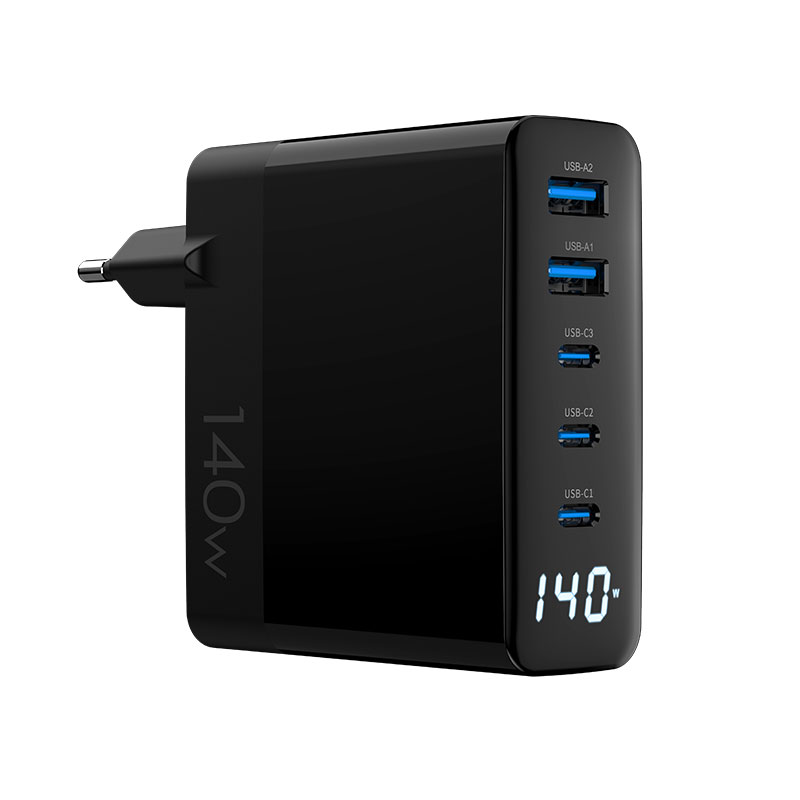
Check 2: cable rating and identification
The cable is part of the power path and a common cause of an under-delivering charger.
Verify the rated current, the connector type and whether the cable carries the identification the laptop expects. A 100W charger shipped with a 60W cable will not deliver its rating to a device that asks for more, and the customer attributes the shortfall to the charger. If the cable is supplied, it belongs in the specification, the certification file and the packaging claim; if it is not, the required rating should be stated on the packaging so the customer can match it.
Check 3: sustained thermal behaviour
Measure after a sustained full-load run, in the shipping enclosure, at a stated ambient – not during a short test.
Laptops draw power for hours, so the relevant figure is the temperature rise after the product has been running at load, not the temperature it reaches in a minute. Ask whether the design derates at a defined point and what the control system does when it reaches that point. A documented derating condition is acceptable; an undocumented one becomes a warranty conversation with a customer who noticed the charger slowing down.
Check 4: the process records behind the batch
Ask for the records, then ask the factory to demonstrate one.
The stages that matter are incoming inspection against the approved BOM, in-process checks on soldering and assembly, a functional test applied to every unit, aging under load and outgoing inspection with sampling. Then pick a finished carton and ask to trace it back to its batch, component lots and test data. Records that exist but cannot be linked are not traceability; they are storage.
| Check | Evidence that passes | What a failure looks like |
|---|---|---|
| Profile support | Negotiated rate recorded with the actual laptop | Rate below the laptop’s preference, or drops when a second device is added |
| Cable | Rated current and identification verified | Supplied cable below the charger rating |
| Thermal | Sustained measurement in the shipping enclosure | Short-test measurement only; undocumented derating |
| Process records | Carton traced to batch and component lots | Records stored but not linked; no aging log |
| Certification | Report naming the model and the markets | Certificate without a model, or covering a sibling product |
Check 5: certification reports that name the model
Certification is model and market specific, and higher-power products can attract additional requirements.
Ask which reports exist, which markets they cover, and what changes when your brand and model designation are applied. Where the platform is already certified, the work is documentation and marking rather than new testing; where it is not, budget the test programme into the schedule. A report that names a different model does not describe the product you are buying, even when the two sit in the same family.
Running the checks in one visit
Sequence the visit so the engineering checks happen first and the documentary checks follow.
Start at the functional test station with your laptop and watch the negotiation. Measure the enclosure temperature during a sustained run. Then walk the line in production order, ask for the calibration records of the test equipment used on your product, and finish with the traceability exercise on a real carton. The documentary requests can be followed up in writing, but the three engineering checks should be completed while you are on site, because they are the ones that cannot be reconstructed later.

FAQ
What is the most common reason a laptop charges slower than expected?
The charger does not offer the profile the laptop prefers, or the cable limits what the device will accept. Both can be verified in minutes with the actual laptop and a test instrument. Ask whether the charger offers the profile the laptop prefers and whether the cable limits what the device accepts, because both can be checked in minutes with the actual laptop.
Do laptop chargers need different certification from phone chargers?
The frameworks are the same; higher-power products can attract additional requirements, and certification remains model and market specific. Confirm the reports name the model being quoted. The frameworks are the same, and higher-power products can attract additional requirements while certification remains model and market specific, so confirm the reports name the model being quoted rather than a sibling. Ask for the reports by model number.
Should the cable be included in the specification?
Yes. Its rating and identification decide what the system can deliver, and it belongs in the certification and packaging documentation as well as the quotation. Its rating and identification decide what the system can deliver, and it belongs in the certification and packaging documentation as well as the quotation rather than only in the accessory list. Ask for the cable specification in the quotation.
How long does a laptop charger programme take?
A platform-based programme is driven by the production slot and packaging approval. A new enclosure adds tooling loops and a certification review to the critical path. A platform-based programme is driven by the production slot and packaging approval, while a new enclosure adds tooling loops and a certification review to the critical path rather than to the quotation. Ask which of the two paths the programme is on.
Next step
Send the laptop models, the required wattage and the target markets to Wecent Group through the contact page to arrange the five checks on a sample or request the documentation pack. Related reading: quality control, GaN charger applications and our charger factory. External references: USB-IF documentation, IEC standards, ISO 9001, FCC equipment authorisation, EU CE marking and EU energy-efficient products.