
A branded phone charger programme can open at 200 pieces per model – and that number, not the unit price, is usually what decides whether a first channel test is affordable. The same opening quantity applies to a bundle or a private-label box, because the tooling and the electrical design already exist in each case. What changes between the options is not the minimum; it is the packaging complexity, the certification scope and how much of the range you have to commit to before you have any sell-through data.
This guide is part of our Charger Factory & Production. Read the full topic guide for the decisions that come before and after this step.
Phone charger manufacturer: the four programme options and what separates them
Four options cover most phone charger programmes.
An entry-tier platform SKU, a bundle that adds a cable or a pouch, a private-label packaging version, and a multi-port step-up for tablets and laptops. The variables that separate them are the opening MOQ, the new tooling, the packaging versions to manage, the certification scope and the channel the product is built for.
The reason to compare them as options rather than as a ladder is that the trade-offs run in different directions. A bundle increases the unit value and the packing labour but does not change the electrical design. A private-label box increases the artwork and print commitment without changing the product. A multi-port step-up changes the thermal load and the firmware, which makes it the most expensive option to add and the one that most benefits from being sequenced later.
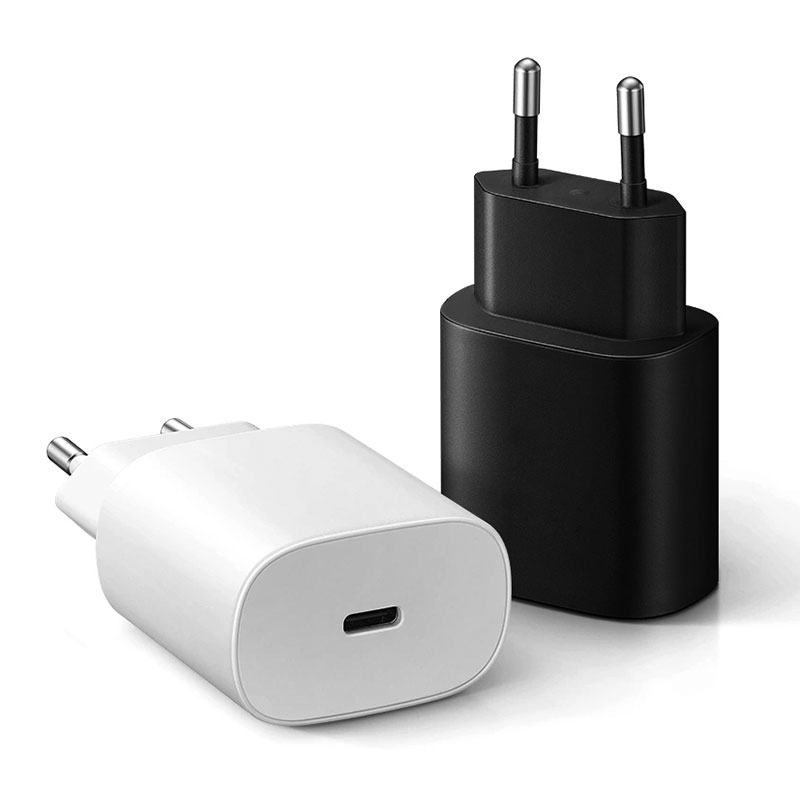
Option 1: the entry-tier platform SKU
This is the option with the least new tooling and the shortest schedule.
The 20W-45W tier uses the most mature platforms, and because the mould and the safety-critical design exist, a branded run changes the logo, colour, label and packaging only. Samples with branding are typically prepared in two to three days where the platform allows, and quotations are returned within 24 hours on business days. The commercial limitation is differentiation: the same platform may be offered to other customers in different branding, so the product competes on price, packaging and channel rather than on the design.
Option 2: the bundle programme
A bundle raises the average order value without changing the electrical design – but it does change the packing line.
Adding a cable, a pouch or an accessory set means a different insert, a different packout sequence and an extra line in the specification. The cable rating must match the charger output, and the accessory content should be included in the compliance documentation. The trade-off is straightforward: more value per unit, more packing labour and more inventory items to manage. Bundles also change the carton volume, so the freight calculation has to be redone rather than assumed.
Option 3: the private-label packaging version
Packaging is the cheapest way to create a marketable variant and the easiest place to create operational complexity.
A custom retail box adds artwork, print plates, an insert and language versions. At low volume the setup cost is spread over fewer units than anywhere else in the programme, which is why a simpler packout often reduces the unit cost more than any negotiation on the charger itself. Where several markets are involved, a master design with market-specific panels or sleeves usually costs less than separate packaging per market.
| Option | New tooling | Opening MOQ | Main trade-off | Best fit |
|---|---|---|---|---|
| Entry-tier platform SKU | Branding and label | From 200 pcs per model | Limited differentiation | First channel test |
| Bundle programme | Insert and packout | From 200 pcs per model | Packing labour and inventory | Retail and gifting channels |
| Private-label packaging | Print plates and insert | From 200 pcs per model | Setup cost at low volume | Branded retail presence |
| Multi-port step-up | New thermal and firmware work | Depends on the platform | Heat density and complexity | Second-season extension |
Option 4: the multi-port step-up
This is the option that should be sequenced rather than launched.
Adding ports changes the thermal load, the power-sharing rule and often the certification scope, because the internal layout and the electromagnetic behaviour move with the design. Where a higher tier exists on the same platform, the extension is cheaper; where it requires a new enclosure, the programme becomes a development project. The commercial argument for waiting is that the sell-through data from the entry SKU tells you which tier to add and at what price point.
What the retail calendar does to the comparison
Retail windows are fixed, and the factory calendar fills ahead of them.
An entry-tier platform order can often be placed inside a quiet window with a short lead time, while a new enclosure with tooling and certification cannot be compressed into the same weeks regardless of quantity. If the launch date cannot move, the practical choice is often a platform option now and the differentiated version in the following season. Plan backwards from the retail window: artwork approval, packaging proof, production week, pilot run and specification freeze each need a date and an owner.
Certification and labelling across the options
The platform’s reports cover the unchanged design; your brand changes the label, the model designation and the importer details.
Ask which reports exist, which markets they name and whether the model on the report matches the product you are buying. Wecent Group prepares certification groundwork for CE, FCC, RoHS, PSE and KC and confirms the current status per model. For bundles, confirm that the accessory set is included where the combination is assessed together, and for multi-region programmes confirm the plug strategy before the label is printed.
How to test a range without over-committing
Open with one option, measure the channel, then extend from the same platform.
The sequence that works most often is an entry-tier SKU with a packaging template that can accept market variants, followed by a bundle or a private-label box once the sell-through is known, and a multi-port tier only when the data supports it. Each step reuses the platform, the approval work and the certification file, so the cost of the second and third products is artwork and samples rather than a development cycle.
FAQ
What is the minimum order for a branded phone charger?
From 200 pieces per model on an existing platform. A new enclosure carries tooling and therefore a higher economic minimum. From 200 pieces per model on an existing platform, and a new enclosure carries tooling and therefore a higher economic minimum set by the moulding economics of the die rather than by the order size. Ask which constraint sets the opening quantity.
Should the first order be a bundle or a plain SKU?
If the channel is gifting or retail, a bundle raises the perceived value; if it is a price-driven listing, a plain SKU keeps the packout simple and the unit cost low. If the channel is gifting or retail a bundle raises the perceived value, while a price-driven listing keeps the packout simple and the unit cost low, so the channel decides.
Do more ports mean a new certification?
They change the internal layout and thermal behaviour, which can require a review. Where a higher tier already exists on the platform, the extension is cheaper. More ports change the internal layout and thermal behaviour, which can require a review, and where a higher tier already exists on the platform the extension is cheaper than a new platform. and the review is a measurement rather than a note.
How fast can a branded sample be ready?
Typically two to three days where the platform allows, with logo and finish applied. Packaging proof takes longer because of the print plates. Typically two to three days where the platform allows, with the logo and finish applied, while the packaging proof takes longer because of the print plates rather than the sample. Ask for the marking lead time with the quotation.
Can the packaging be added later?
Yes, but plates, insert and language versions are new tooling. Planning them against the full market list at the start costs less than adding them market by market. Plates, insert and language versions are new tooling, so planning them against the full market list at the start costs less than adding them market by market later. and the language versions are the largest of the three.
Next step
Send the channel you are targeting, the markets and the volumes you expect to Wecent Group through the contact page. The reply states the platform options, the MOQ, the packaging commitment and the sample timing, so the four options can be compared on the same terms. Related reading: wholesale chargers, OEM/ODM manufacturing and quality control. External references: USB-IF documentation, Qualcomm Quick Charge, IEC standards, EU CE marking, FCC equipment authorisation and ICC Incoterms.