
Two cable programmes ordered the same length and the same connector, and one of them charged a laptop at the top tier while the other settled two levels below. The difference was not the length or the moulding; it was the conductor gauge and the identification the device expected to find.
USB C cable manufacturer: the four decisions
The rating, the identification, the construction and the test.
Each is settled before the sample is approved, and each is visible on the finished cable only through its behaviour rather than its appearance. A cable that carries the right number of wires but the wrong rating looks identical to one that works.
Two cables, one visible difference
The difference was inside the moulding.
Both cables were rated on the packaging as supporting the full current. The first met the gauge and carried the identification the device reads at the higher tier; the second used a lighter conductor and no identification, so the device negotiated conservatively. The customer saw a charger that underperformed.
Decision one: the current and the gauge
The gauge follows the current, and the length follows the gauge.
A cable carrying higher current over a longer run drops more voltage in the conductor, and the device reads the drop as a lower capability. That is why a two-metre cable and a one-metre cable of the same nominal rating can behave differently on the same charger, and why the length belongs in the specification rather than in the order line.
Decision two: the identification the device reads
It is a component, not a marking.
The identification is an electronic element inside the connector that tells the device what the cable supports. A cable without it can still carry current, but the device will not negotiate the higher tier, and the shortfall appears as a charger problem rather than a cable one.
Decision three: the construction
Three parts, and the third is where failures show.
The conductor and its gauge, the shielding and the jacket, and the strain relief at the connector. The first two are specified from the electrical requirement, and the third decides the field failure rate, because most cable returns are mechanical rather than electrical.
Decision four: the test behind the claim
Four tests, and each produces a number.
The voltage drop at the rated current, the negotiated tier at the far end, the bend and pull cycle count, and the connector’s retention force. A cable programme without those four is describing a construction rather than a performance.
| Decision | What it fixes | How it is verified | Failure if skipped |
|---|---|---|---|
| Current and gauge | Voltage drop over the length | Measurement at rated current | A tier that is never reached |
| Identification | What the device will negotiate | Correct tier at the far end | The device settles lower |
| Strain relief | Field failure rate | Bend and pull cycles | Returns at the connector |
| Retention force | The connector staying seated | Measured on finished cable | Intermittent charging |
What the customer experiences when the rating is short
It looks like a charger fault rather than a cable fault.
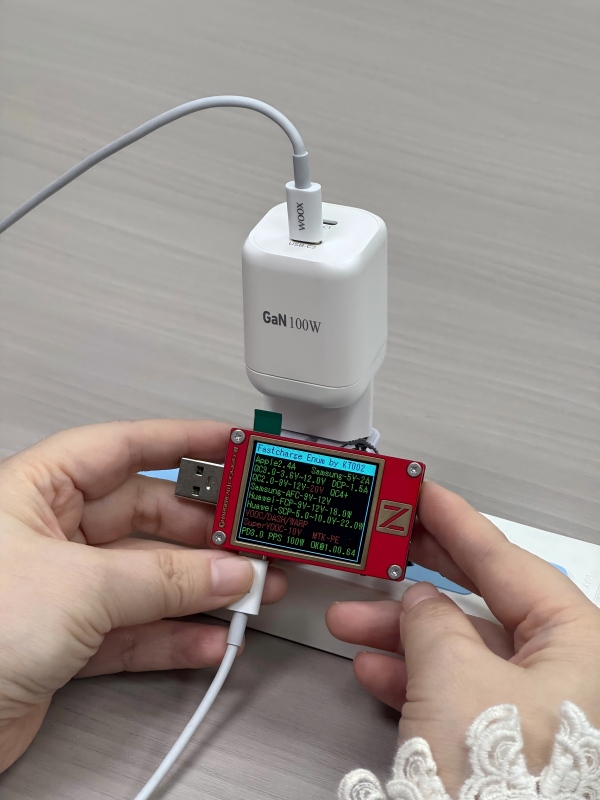
The device charges more slowly, the user reports the charger as faulty, and the returned product comes back with the accessories. The cable is then tested only if someone thinks to test it, which is why the accessory rating belongs in the same documentation as the charger’s specification.
Verifying the cable before ordering
Four items, and the second is the one usually taken on trust.
The gauge and length stated in writing, the identification present in the connector, the test records for the four measurements, and a sample measured against the device the programme supports. A cable programme that provides those four can be compared with another on the same basis.
Where cable programmes go wrong
Three patterns, and the third is the most expensive.
A specification that names the connector but not the current; a sample approved on appearance; and a claim on the packaging that names a tier the supplied cable cannot carry. Each is settled before the moulding tool is cut rather than after the first shipment.
FAQ
Is a thicker cable always better?
It carries more current with less voltage drop, and it also resists bending more and costs more in copper. The right gauge is the one that meets the drop requirement at the length being supplied, so the decision follows the length rather than the marketing description of the cable.
Does the identification component affect cost much?
It adds a component and a soldering step to the connector assembly, and it is a small part of the cable cost. Its absence, however, limits the tier the device will negotiate, which turns a saving in the assembly into a performance complaint at the customer.
Why do most cable returns come from the connector?
Because the connector is where the mechanical load is applied: every insertion, every pull and every bend acts on the same junction. Strain relief is therefore specified with a cycle count, and the specification is written around the way the cable is used rather than around its electrical rating alone.
Can one cable serve several chargers in a range?
It can where the rating covers the highest tier in the range and the length is the same, because the lower tiers are negotiated downwards without difficulty. Where the range includes a longer cable or a higher tier, the two specifications are kept separate rather than averaged into one.
Next step
Send the device list, the required tier and the cable length to Wecent Group through the contact page. The reply sets out the gauge, the identification, the construction and the four tests. Related reading: charger manufacturing services, OEM and ODM charger manufacturing and charger quality control. External references: USB Implementers Forum charger specification, USB-IF compliance programme, USB-IF document library, IEC standards, BSI standards and Intertek testing services.
{“@context”:”https://schema.org”,”@type”:”FAQPage”,”mainEntity”:[{“@type”:”Question”,”name”:”Is a thicker cable always better?”,”acceptedAnswer”:{“@type”:”Answer”,”text”:”It carries more current with less voltage drop, and it also resists bending more and costs more in copper. The right gauge is the one that meets the drop requirement at the length being supplied, so the decision follows the length rather than the marketing description of the cable.”}},{“@type”:”Question”,”name”:”Does the identification component affect cost much?”,”acceptedAnswer”:{“@type”:”Answer”,”text”:”It adds a component and a soldering step to the connector assembly, and it is a small part of the cable cost. Its absence, however, limits the tier the device will negotiate, which turns a saving in the assembly into a performance complaint at the customer.”}},{“@type”:”Question”,”name”:”Why do most cable returns come from the connector?”,”acceptedAnswer”:{“@type”:”Answer”,”text”:”Because the connector is where the mechanical load is applied: every insertion, every pull and every bend acts on the same junction. Strain relief is therefore specified with a cycle count, and the specification is written around the way the cable is used rather than around its electrical rating alone.”}},{“@type”:”Question”,”name”:”Can one cable serve several chargers in a range?”,”acceptedAnswer”:{“@type”:”Answer”,”text”:”It can where the rating covers the highest tier in the range and the length is the same, because the lower tiers are negotiated downwards without difficulty. Where the range includes a longer cable or a higher tier, the two specifications are kept separate rather than averaged into one.”}}]}