
A brand paid for tooling on a charger that nobody could tell apart from the platform it came from. The new enclosure moved the outline by two millimetres, the certification file had to be rebuilt, and the first order carried a minimum an order of magnitude above the platform route. The differentiation the tooling was meant to buy never reached the shelf, because a buyer compares wattage, ports and price long before they compare a silhouette.
This guide is part of our OEM & ODM Charger Programmes. Read the full topic guide for the decisions that come before and after this step.
Rebrand charger projects: three levels and what each one actually buys
A rebrand charger can be a label, a variant or a new design, and the level decides almost everything else.
Rebadging puts a brand on a product whose design already exists. Re-specification changes the configuration inside the tested envelope – ports, plug kits, cable ratings, small mechanical details. Co-development produces a design the brand owns, with tooling, a test programme and a commercial minimum that follows from both.
The three levels are not a quality ladder. Each answers a different commercial question: how fast the product reaches the shelf, how much of the product the brand controls, and how much of the cost becomes fixed rather than variable. A programme that knows which question it is answering avoids the most expensive mistake in this category, which is paying for the third level to solve a problem the first two would have solved.
Level 1: rebadging a certified platform
The fastest level, and the one with the smallest fixed cost.
Artwork, colour, finish, cable branding and packaging change; the board, the enclosure and the electrical design do not. Certification work reduces to a label update and a technical file that records the brand as the responsible party. The opening quantity can be small because the tooling and the test programme are already paid for, and the reorder cycle is short because nothing in the supply chain has to be reopened.
Level 2: re-specification inside the tested envelope
The level most commercial briefs actually need.
A specific port mix, a regional plug kit, a cable rating or a small mechanical change can usually be made inside the platform’s characterised range. The cost moves from artwork to engineering: documentation, sample verification and, where a change touches a characterised parameter, a review by the test house. Ask which requested changes stay inside the envelope and which step outside it, because that line decides whether the file is updated or the certification re-earned.
Level 3: co-development and what ownership means
Tooling, a trial loop and a test programme, with the opening quantity following the moulding economics.
Level 3 is the only level that produces a form factor another brand cannot order. It is justified when the shape is the reason customers buy, when the volume can amortise the tooling, or when the brief needs an output, a connector or a thermal position no platform provides. Ownership is the second product of this level: tooling paid by the brand is the strongest available claim on exclusivity, and it should be assessed against the volume that can carry it rather than against the forecast that motivated it.
| Level | What changes | Tooling | Certification work | Opening quantity | Exclusivity |
|---|---|---|---|---|---|
| 1 Rebadge | Artwork, colour, finish, packaging | None | Label and file update | Smallest | None on the form |
| 2 Re-specify | Ports, plugs, cable, small mechanical | Small tooling only | Review, or new submission | Set by the change | Limited to the variant |
| 3 Co-develop | Enclosure and electrical design | Mould and trial loops | New test programme | Set by the moulding batch | Strongest, with paid tooling |
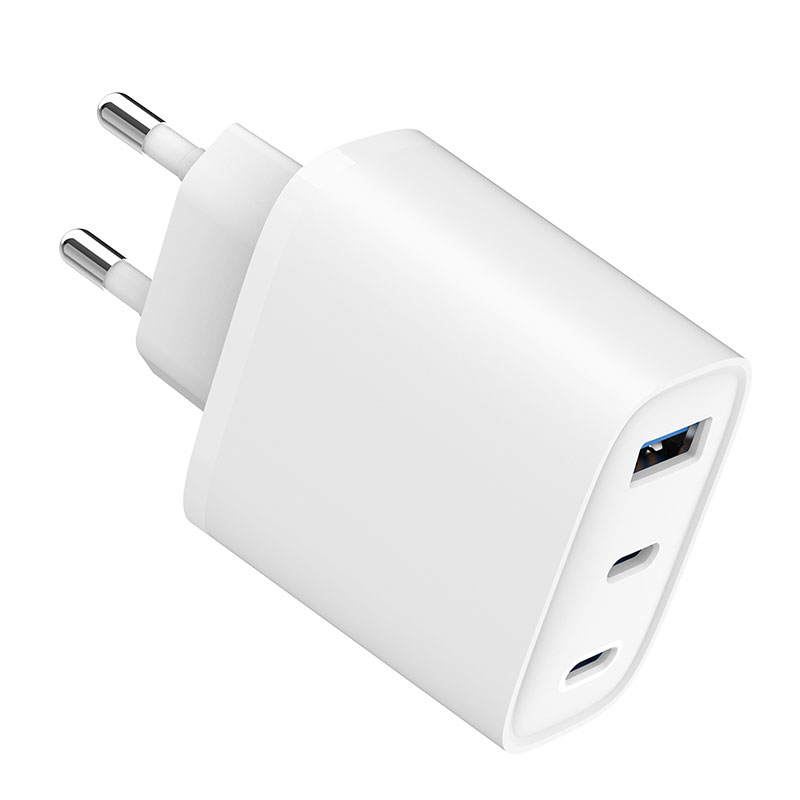
What the shelf actually sees
The customer’s comparison is narrower than the brand’s design review.
Wattage, port count, price and packaging decide most purchases in this category, and the enclosure decides a much smaller share. That is not an argument against co-development; it is an argument for spending the tooling budget where a customer notices it. A brand that owns its packaging system, its cable and its channel story can differentiate on a rebadged platform, while a brand that owns an expensive enclosure and a generic carton usually cannot.
Where the money goes at each level
Fixed cost and variable cost move in opposite directions as the level rises.
Level 1 concentrates cost in artwork and print setup, with a low per-unit price and a small minimum. Level 2 adds engineering and documentation, which are fixed and paid once. Level 3 adds tooling and a test programme, the two largest fixed items, and the per-unit price falls only when the volume is large enough to absorb them. The practical question is not which level is cheapest but which level’s fixed cost the twelve-month forecast can carry.

Choosing the level for a first programme
Start at level 1 or 2 and let the reorder rate decide.
A first programme has one job: to prove the channel sells the product. Starting at level 1 or 2 keeps the fixed cost low enough to survive a slow launch, and the sales data then shows whether level 3 is worth its tooling. Brands that begin at level 3 sometimes discover that the specification, not the enclosure, was what the market wanted, and that discovery is expensive when it arrives with a mould attached.
FAQ
How long does a rebrand charger programme take?
Level 1 usually runs from a few weeks to a couple of months from frozen artwork to shipment, because only the label and the packaging change. Level 2 adds engineering and documentation time. Level 3 adds tooling and a test programme and is measured in months. Level 1 usually runs from a few weeks to a couple of months from frozen artwork, because only the label and the packaging change.
Can a rebranded charger keep the original certification?
Where the electrical design, the enclosure and the tested parameters are unchanged, the branded build is covered by the existing reports with an updated label and technical file. A change that moves a characterised parameter turns the update into a new submission. Where the electrical design, the enclosure and the tested parameters are unchanged the branded build is covered, while a change to a characterised parameter is a new submission.
What does level 3 add that level 2 cannot?
A form factor that no other customer of that platform can order, and the ability to change the electrical architecture. Level 2 can change what the product does within the tested design; level 3 can change the design itself, at the cost of tooling and a new test programme. Level 2 can change what the product does within the tested design, while level 3 can change the design itself at the cost of tooling.
Is paid tooling the same as exclusivity?
It is the strongest claim available, and it still needs to be written down. State which part is exclusive, for how long, and whether the factory may build the same enclosure for another brand with different artwork. Tooling ownership without those sentences produces a dispute rather than a moat. State which part is exclusive, for how long, and whether the factory may build the same enclosure for another brand.
Which level fits a first order of 500 pieces?
Level 1 or level 2, unless the enclosure is the product’s reason to exist. A 500-piece order cannot carry a mould and a test programme efficiently, and the per-unit cost of doing so is usually visible to the channel even when it is invisible in the quotation. A 500-piece order cannot carry a mould and a test programme efficiently, so the level follows the volume as much as the ambition.
Next step
Send the target markets, the port and plug configuration, the branding level and the forecast to Wecent Group through the contact page. The reply states which level fits the brief, what each level changes in the compliance file and where the opening quantity lands. Related reading: charger manufacturing services, our charger factory and wholesale charger programmes. External references: USB-IF compliance programme, IEC standards, EU CE marking rules, UL standards and certification, TUV testing services and US Department of Energy.