
Custom Wireless Charger
A custom wireless charger built on a platform that is already certified: your logo, your colour, your material face and your retail packaging — from 200 pcs per model, with samples in 2–3 days.
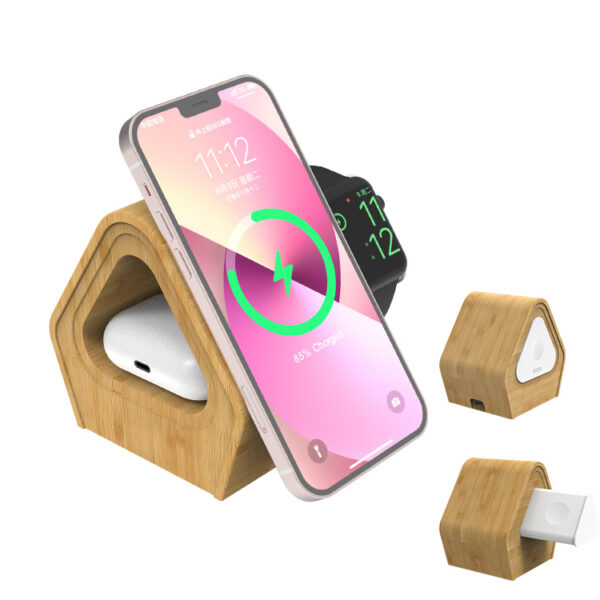
The dividing line is what stays fixed: the coil, the magnet array and the safety circuitry, because those are what the test reports cover. Everything the buyer sees and touches — colour, material face, print method, box, bundle — is yours, and that is why branding a settled platform keeps samples at days rather than months.
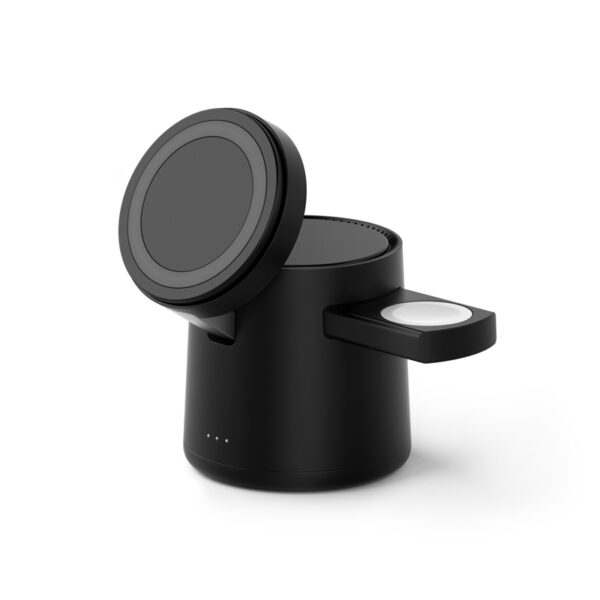
Customisation on a tested platform is what keeps the MOQ low
There are two ways to get a branded wireless charger. One is to design the electronics, the coil, the magnet array and the housing from scratch — which is a real project with tooling, safety testing and a timeline measured in months. The other is to start from a platform that already ships, and change what the customer sees and touches.
Almost every branded programme lands on the second route, because the parts that carry your identity are the parts buyers judge: the face material, the weight in the hand, the logo method, the box. The electrical design is the part that has to stay identical, because that is what the existing test reports and certification cover.
- What is genuinely yours. Colour, material face, logo method, packaging artwork, accessory bundle and the model designation on the label.
- What stays fixed. The coil, the magnet array, the charging profile and the safety circuitry — which is why the certification work is documentation rather than new testing.
- What that buys you. Samples in 2–3 days, MOQ at 200 pcs, and a specification that does not move between shipments.
Where customisation money actually shows up
Not every change costs the same. Printing is cheap per unit and changes nothing about the tooling; a new shell colour is a paint or mould decision with a minimum run; a new face material is the most visible change and the one most likely to move the unit cost. If the budget only stretches to one, spend it on the surface the buyer touches and the box they open.
| Change | Unit cost impact | Effect on lead time |
|---|---|---|
| Logo and printing | Low — applied per unit | None: 2–3 days on a sample |
| Shell colour / finish | Low to medium, paint minimum per run | None once the colour is confirmed |
| Face material (bamboo, PU, silicone) | Medium — material and assembly | Adds days if the material has to be sourced |
| New packaging | Medium — print plates and inserts | Artwork approval drives the mass-production date |
The tooling and MOQ note explains how each line is quoted and why the unit price steps down with volume.
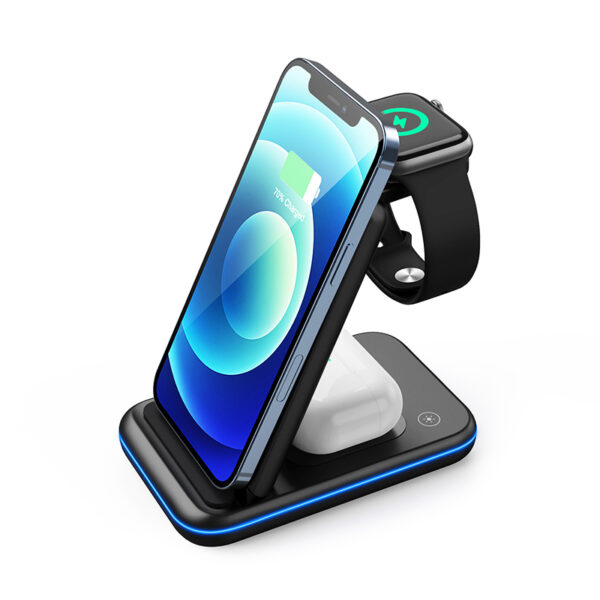
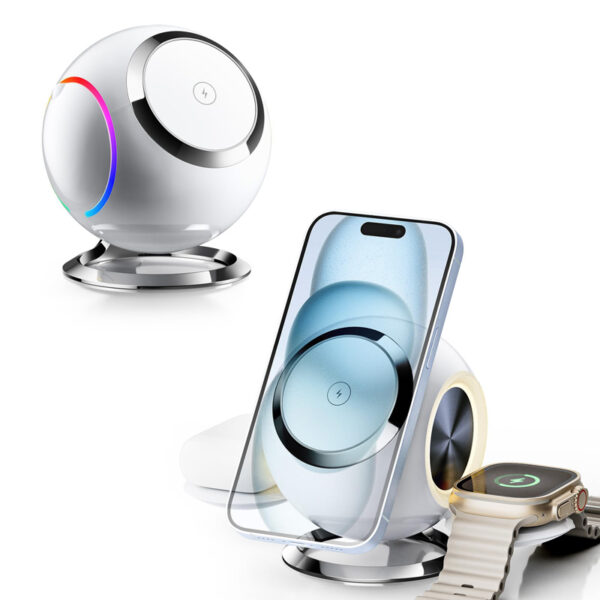
The options on a custom wireless charger
Everything below is applied on top of a platform that is already tested and shipping.
- Logo and printing — silk-screen, laser etching or UV printing, single or multi-colour, placed to your artwork.
- Colour and finish — black and white as standard, plus custom shell colour and surface texture.
- Material face — ABS, PC, bamboo or wood, PU leather and silicone for the contact surface.
- Packaging and bundle — colour box, insert and sleeve artwork, or neutral packing, plus cable, adapter or pouch.
- Coil arrangement — single pad, twin coil or a 3-in-1 board for phone, earbuds and watch.
Custom wireless charger — what is quoted
| Charging standard | Qi2 and MagSafe-compatible 15W platforms; exact profile confirmed per model on the datasheet |
|---|---|
| Coil layout | Single, twin or three-coil (phone + earbuds + watch) |
| Branding methods | Silk-screen, laser etching, UV printing; label and model designation |
| Shell | Black and white as standard; custom colour and texture available |
| Face material | ABS, PC, bamboo or wood, PU leather, silicone |
| Packaging | Colour box, insert and sleeve artwork, or neutral packing for private label |
| Bundle | Cable, USB-C adapter or pouch quoted with the packaging |
| Certifications | CE, RoHS, FCC, UKCA, PSE, KC, SAA and CB reports for a custom wireless charger, depending on the target market |
| MOQ | 200 pcs per model for a branded custom wireless charger; a trial quantity can be split across a few SKUs |
| Samples | 2–3 days with your logo and finish applied to the custom wireless charger |
| Mass production | 7–15 days after sample and artwork approval for the custom wireless charger |
| Carton | 50 pcs per carton as standard for the custom wireless charger, or customised to your requirement |
The rows above describe a standard custom wireless charger. Custom power stages, coil layouts, plugs and packaging are quoted per project, and every figure is confirmed on the datasheet before a sample is built.
Platforms that take customisation well
WEG-2201 bamboo 3-in-1
Bamboo face, 15W MagSafe — the material does most of the branding work.
Z8A foldable — gift programmes
Built for corporate gifting: foldable, light, large print area.
How a custom wireless charger is built and checked
Branding is applied inside this route rather than after it: the platform is built and checked first, then the logo, the finish and the packaging are applied and re-checked before packing.
Material preparation and checking
Components are checked against the approved bill of materials before branding begins — coil, magnet array, shielding, cable and the shell that will carry your colour.
First-piece quality confirmation
The first branded unit of a run is built and checked against the approved sample: logo position, print registration, colour match and finish, alongside the charging behaviour.
Assembly on static-protected lines
Boards are assembled on static-protected lines, and the branded shell and contact face are fitted and inspected at their own station so a printing fault is caught before packing.
Visual inspection rounds
Repeat visual inspections verify print or etch quality, colour consistency, surface finish, coil seating and the cosmetic condition of the branded face.
Aging under load and electrical testing
Every unit runs an aging cycle under load and is re-measured afterwards, so a branded batch behaves exactly like the plain sample it was approved from.
Charging and protocol verification
Output voltage and current are measured across every coil, and the profile is verified after the housing has been closed — because the branded shell is part of the thermal path.
QA sampling, packing and shipment inspection
Sampling runs before packing, and the colour box, insert and sleeve are checked against your approved artwork before the batch report is signed off.
The gates are the same for a stock unit and a branded one — the branding is applied on top of a platform that was already tested, which is why nothing on this list changes when your logo goes on.
What custom wireless chargers are usually bought for
Corporate gifting
A large print area, a low unit cost at 200–500 pcs, and packaging that survives shipping.
Retail own-brand
Your colour and box on a certified platform, sold as your SKU rather than a generic one.
In-box accessory
Matched to a device launch, with the coil layout chosen around the devices in the box.
Hospitality and fleet
Neutral or lightly branded units for hotel rooms, meeting rooms and shared desks.
Certifications and what comes with the shipment
The file for a custom wireless charger is assembled from the first sample rather than hunted down before dispatch, so the paperwork matches the market the container is going to.
CE / UKCA
European Union and United Kingdom market access for the finished unit and its power supply.
FCC
United States electromagnetic compliance for the finished unit.
RoHS / REACH
Restricted-substance documentation for the European market.
PSE / KC
Japan and Korea market documentation, quoted with the plug kit.
CB / SAA / GS / ETL
Additional reports quoted where the channel or retailer requires them.
ErP efficiency
Efficiency documentation for the EU external power supply regulation.
Reference standards behind this page: Wireless Power Consortium (Qi / Qi2), EU external power supply regulation (ErP), EU CE marking and the USB Implementers Forum for USB-C and Power Delivery specifications.
Related guides and platforms
OEM vs ODM and private label
The difference that matters, and how a project runs from sample to container.
Sequencing an OEM project
The order tooling, certification and packaging should happen in.
Packaging cost engineering
Where a box stops being packaging and starts being freight.
All wireless and GaN chargers
The full platform list with wattage, ports and MOQ.
MOQ and tooling economics
Where the 200 pcs threshold comes from and how tooling is quoted.
Certification for the EU and US
What the compliance file needs, and when to start it.
Custom wireless charger — FAQs
What is the minimum order for a custom wireless charger?
Custom work starts at 200 pcs per model. That threshold exists because the branding steps — print plates, colour batches, box artwork — have their own minimums, and below 200 pcs those minimums stop being worth amortising.
Can I change the electronics, not just the outside?
Yes, but that is a different project: a new coil, magnet array or charging profile means new safety and EMC testing, so the timeline is measured in months and the MOQ is higher. Most branded programmes stay on an existing platform and change what the buyer sees.
How do I get a sample with my logo?
Send the artwork and tell us the platform. The sample ships in 2–3 days with your logo and finish applied, and the branding method is confirmed on that sample before the production run.
Which branding methods do you offer?
Silk-screen printing, laser etching and UV printing — single or multi-colour, placed to your artwork. Method depends on the face material: laser etching suits wood and metal, printing suits ABS and PC.
Can the packaging be fully custom?
Yes. The colour box, insert and sleeve can all be redrawn around your artwork, or the unit can ship in neutral packing. Cartons ship 50 pcs as standard, or to your own requirement.
Do the certifications still apply after branding?
Yes, provided the electrical design is unchanged. Branding changes the manufacturer identification, the model designation and the label, so the work is documentation and marking rather than new testing.
How long does the artwork and sample cycle take?
Samples normally ship in 2–3 days with your logo and finish applied. Mass production runs 7–15 days after sample and artwork approval, so the artwork is usually the critical path rather than the production.
What happens if a unit fails in the field?
The platform carries a 2-year warranty, which applies to a branded unit exactly as it does to a stock one. The complaint route is a 24-hour first response and a batch report, so the answer names the production run and the corrective action instead of only offering a replacement.
Can you match an existing product we sell?
Send the specification or the unit itself. If the electrical design can be matched on a platform we already build, the quote is straightforward; if it cannot, we say so and explain what a new design would cost.
Is MagSafe or Qi better?
For a branded product the answer is usually “both”: a Qi2 or MagSafe-compatible platform charges magnetically aligned phones at the higher band and still charges any Qi device at its own rate. Choosing MagSafe-style magnets adds alignment and cost; leaving them out lowers the price and puts placement back on the user.
What is the downside of wireless charging?
Two things, and both are design problems rather than wireless problems: the transfer loses more energy than a cable, so a badly aligned pad heats up; and a phone in a thick case couples less well. A magnetic platform removes the first by holding the coil centred, which is why most branded programmes start there.
How do I build my own wireless charger?
Building one from parts is a hobby project; building one for sale means starting from a platform that already holds its safety and EMC reports and applying your branding to it. That is the route we quote, because it puts a certified unit on the shelf in weeks instead of designing a new coil and certifying it.
Custom wireless chargers in more detail — branding, materials and OEM terms Know more Know less
Custom, OEM and private label — what the words mean here
Custom usually means applying your branding to a product that already exists: a logo, a colour, a material face and a box. OEM means the product is built around your specification on a platform the factory already holds reports for. Private label means the same product ships under your brand with your packaging and no visible reference to the original model.
All three start from a platform that is in production, which is why they can be sampled in days rather than months. Designing new electronics is a different project with new safety and EMC testing.
What can be changed on a wireless charging pad
Logo and printing (silk-screen, laser etching or UV printing), shell colour and surface texture, the contact-face material, the coil arrangement, the cable or adapter bundle, and the retail packaging — box, insert and sleeve. The whole top face is available on a flat pad, which is why that format is the usual choice for heavy branding.
What stays fixed is the coil, the magnet array, the charging profile and the safety circuitry. That is what keeps the certification valid and the unit cost predictable.
Materials and finishes for a magnetic wireless charger
ABS and PC are the standard shells and take printing well. Bamboo, wood and PU leather are applied as the contact face or the top surface and change how the product reads in the hand — they also change the unit cost and sometimes the lead time if the material has to be sourced.
Colour sits in the middle: a custom shell colour is a paint or mould decision with a minimum run, which is why it is quoted separately from the printing.
Artwork, packaging and the approval cycle
The artwork is usually the critical path, not the production line. Print plates and packaging dies are made from the approved file, so a late change means a new plate rather than a new print run.
The sequence that avoids it: agree the printing method on a plain sample first, then finalise the box artwork while the sample is in transit, then approve both together. That keeps mass production at 7–15 days after approval instead of restarting the clock.
Custom wireless chargers for corporate gifting
Gift programmes have their own constraints: the unit has to survive shipping, the print area has to be large enough to read, and the box has to open without instructions. A folding 3-in-1 or a flat pad usually wins over a station for exactly those reasons.
Quantities of a few hundred units are typical, which sits comfortably above the 200 pcs per model threshold, and the plug kit is chosen per recipient market rather than per order.
Send your spec, get a costed quotation
Send the platform, the artwork and the quantity. You get the sample date, unit pricing at your volume and the certification list for your markets — plus a plain answer if the artwork cannot be applied the way it was drawn.
- MOQ from 200 pcs per model, splittable across a few SKUs
- Samples in 2–3 days with your logo and finish applied
- Reply within 24 hours on business days