
One Charger Family for Travel, Desk, Home and Everything Between
Every product line has a charging situation it keeps running into — a bag full of bricks, a desk with more devices than sockets, a laptop that slows down under load. Find the scenario below that matches how your users actually charge, and we will size the wattage, port mix and plug kit around it.
Silicon Chargers Are Holding You Back. Here Is How GaN Fixes It.
A silicon adapter loses part of what it converts, and the loss shows up as heat inside a case that has to be big enough to shed it. Push one hard and output tapers, which means the number printed on the label is not what your device still receives twenty minutes in. That taper is why people carry three chargers “just in case”.
Gallium nitride switches faster and cooler, so the same wattage fits in less volume and holds steady through a whole session rather than just at the start of one.
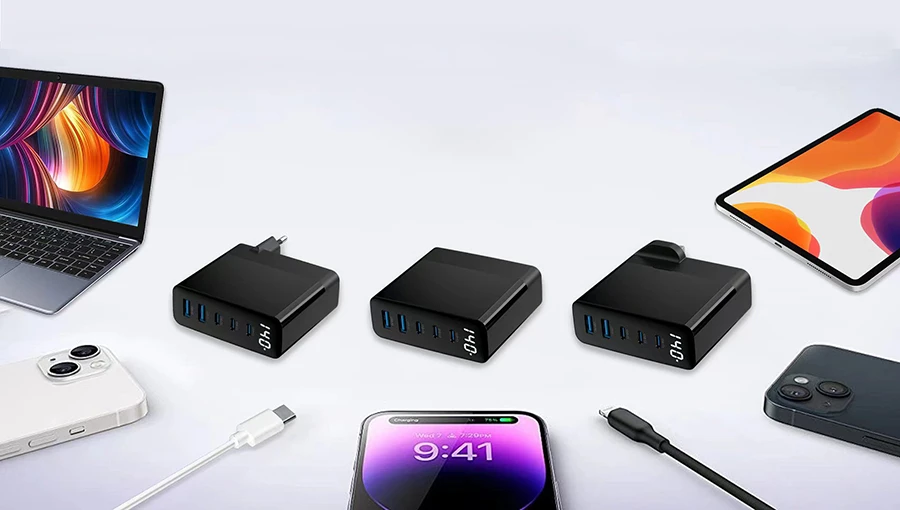
- Three chargers become one — a 65W dual-port unit covers the laptop, the phone and the earbuds that used to each need their own brick.
- Output that stays flat — a 140W platform holds its rating through a long editing or gaming session instead of tapering mid-task.
- One socket, several devices — multi-port layouts turn a single wall outlet into three or four charge points.
Which Scenario Fits Your Users?
Six real-world applications, each with the wattage and port configuration we would recommend — and the model already in production that fits it.
Travelling light: one unit for a whole trip
Three chargers in the bag for one trip? That redundancy costs around 350 g of luggage weight for business travellers and nomads — weight a single 65W dual-port unit can take back.
It splits as 45W to the laptop and 20W to the phone over PD and PPS, inside a 60 × 60 × 30 mm body with EU, UK, US and AUS plugs.
Recommended: 65W wall charger (WEG-65S-CCA)Desk setups: more devices than sockets
Roughly 3.5 devices per desk against 2 available outlets. A four-port charger takes the desk back from that mismatch and removes the cable tangle along with it.
Output is 100W in total, allocated dynamically as 65W to the laptop and 35W to accessories, on a 100–240V input that suits any office supply.
Recommended: 100W charger (WEP-100-CCA)Gaming and editing: output that holds
Performance dropping halfway through a session? Under sustained load a silicon brick throttles; a 140W GaN unit does not, which matters once a laptop alone is pulling 87W or more.
The power stage covers 5–28V at 5A, leaving room on the remaining ports for a monitor light, a capture card or a phone.
Recommended: 140W charger (WEP-140-CCCA)Home hub: everyone charges at once
Six or more devices, three sockets that are actually reachable. A multi-port charger ends the negotiation about who unplugs first.
45W divides as 25W to a tablet and 20W to a phone across dual USB-C, with iOS and Android protocols covered and RoHS compliance behind it.
Recommended: 45W charger (WEG-45-CC)Daily carry: small, light, one port of each
For daily carry, less is the feature. A 33W unit runs the phone at 20W and earbuds at 13W with PPS keeping temperatures down, and stays under 150 g.
The 1A1C layout covers new and legacy devices alike, and the shell comes in black or white to sit inside an existing line-up.
Recommended: 33W charger (WEG-33W-1A1C)Above 100W: workstations and equipment
When the device list outgrows 100W. At 24V/8.3A with a 1.5 m cable, a 160W platform serves workstations and equipment above the usual ceiling while staying backward compatible with smaller gear.
It suits industrial, medical and EV-adjacent projects where steady output and lower cooling costs matter more than the footprint.
Recommended: 160W charger (WEP-160W)GaN vs Silicon: Size, Speed and Safety
The difference your buyers notice is not the material name — it is that the charger stays small, stays cool and keeps delivering the wattage it promises.
| What matters | WECENT GaN chargers | Typical silicon charger |
|---|---|---|
| Heat under load | Surface temperature kept to around 45°C at 65W in our WEG series testing. | Runs hotter and throttles under sustained load, so output drops below the rated wattage. |
| Size for the same output | 65W in a 60 × 60 × 30 mm body; 46.5 × 46 × 28 mm on the WET-67-C platform. | Noticeably larger enclosure and heavier carry weight for the same wattage. |
| Stability during long sessions | Full power maintained for gaming, video editing and other sustained workloads. | Performance drops mid-task once thermal limits are reached. |
| Protection | Eight-layer protection against overvoltage and surges, tested to withstand 10,000V spikes — useful on unstable airport and hotel power. | Protection coverage varies by model and price point. |
| Compliance | Meets 12+ international safety standards for the US, EU and Asia, with CB, GS, CE, ERP, RoHS, REACH, ETL, FCC, UKCA, KC and PSE coverage across the range. | Often certified only for the original sales market. |
Why 200-Plus Brands Keep Their Charging Range Here
Not because of a catalogue page — because a first order stays small, samples arrive quickly, and a defect gets an answer the same day.
Low-risk market tests
Start with a few hundred pieces, test the channel, then scale the SKU that works. Free samples are available for qualified projects.
Warranty that answers
2-year warranty with 24-hour complaint resolution, so your support team is never left holding a defect alone.
Custom, not catalogue
Wattage from 20W to 240W, port mixes, plug kits, materials and retail packaging — tailored to your brand rather than picked off a shelf.
Questions Buyers Ask Our Engineers
How do I choose between 45W, 65W, 100W and 140W?
Do these chargers work with both iOS and Android devices?
Are GaN chargers safe on unstable power, like hotels and airports?
Can one scenario page model be adapted to another scenario?
What does a scenario-based project cost to start?
GaN charger applications — laptops, travel kits, retail programmes and bedside charging Know moreKnow less
Why applications decide the specification
The same GaN platform can be configured for very different jobs. A charger built for a laptop dock has to hold its output for hours; a charger built for a hotel travel kit has to survive being plugged into unfamiliar sockets every week; a charger built for a retail phone programme has to look right on a shelf and meet a price point. Reading the application first is what keeps a project from over-specifying power or under-specifying safety.
Laptop and docking-station chargers (65W-140W)
Replacement laptop chargers are the classic 65W and 100W GaN charger application. A single USB-C port can replace the original brick for thin-and-light laptops, and a 140W multi-port version can feed a laptop, a second display and a phone from one wall socket. PD 3.1 and PPS support matter here because docking stations and modern laptops negotiate higher voltages than older devices.
Travel, hospitality and duty-free kits
Travel adapters with interchangeable EU, UK, US and AUS plugs are sold to airlines, hotel groups and duty-free programmes as part of a comfort kit. The requirements are usually mechanical and regulatory rather than electrical: the plugs must lock firmly, the body must survive repeated packing, and the certificates must cover every country the kit is distributed in.
Phone and accessory retail programmes (20W-45W)
Operator and accessory brands buy 20W to 45W GaN wall chargers in high volume for bundles. Finish, cable matching and carton artwork carry most of the brand value, while PPS and PD support decide whether the charger can advertise fast charging for the phones it ships with.
Wireless charging and bedside applications
Magnetic and Qi2 wireless charging stands are specified for bedside, desk and car-mount use, where cable routing and the viewing angle matter as much as the charge rate. Multi-device stands combine a phone pad, an earbuds pad and a watch puck on one power supply.
How to specify a custom charger
Send four things: the device to be charged, the wattage you want on the label, the plug types and the destination market. From there we confirm the platform, the port mix, the certifications on file and the options that can be branded. A physical sample follows before the bulk order.
Frequently asked questions
- Can one SKU serve several countries? Yes — interchangeable plug heads, or a multi-plug body, let one model cover EU, UK, US and AUS.
- Will a 140W charger damage a phone? No. The device requests the power it wants and the charger delivers only that.
- Can you match an existing product? Yes — send the sample or the specification and we will confirm whether it can be re-engineered on a certified platform.
Tell Us the Scenario. We Will Configure the Charger.
Describe how your users charge — travel, desk, gaming, family or industrial — and we will come back with the wattage, port layout, plug strategy and certification path, plus pricing for your first order.
- 20W–240W coveredOne partner for the whole charger roadmap, not one wattage tier.
- Multi-region by designEU, UK, US and AUS plugs with the certifications your markets require.
- Trial orders from 200 pcsProve the scenario in a real channel before scaling.